
So you wanna be a Tonal Director
In the typical organ company, the Tonal Director is someone who is head of sales, and draws up stoplists according to what the market will bear. However, there are other important things to consider.
I'm not a Tonal Director. But I have worked for several good builders, and had my own workshop for about 40 years. I've worked on a lot of organs and voiced and tonally finished new organs, and rebuilt/revoiced a bunch. I've developed with some ideas and tools that could be useful to you. And I have a large library of historic and contemporary pipe scales. This website is a work in progress. I have a lot of material, which is constantly being added, so keep checking back. I'm not a scholar or historian. These are just my personal notes, gathered over a lifetime; so don't expect them to be properly referenced or attributed.
There is also lots of background information of historic organs, I've freely plagerized from the DeepSeek AI, for the sake of completeness. You can identify the DeepSeek parts by the lack of spelling mistakes. On this page, I'm going to share what I've learned about building good organs. Though it may not seem like it, this site is huge, with more that 1,000 files.
The organ should be tonally planned to serve the musical needs of the church. Besides service playing, the organ should be able to play the repertoire. So a tonal director should be an organist and understand traditional French, German and English organs and their music. Not to build historic copies, but so he is able to build his organs so that music works on them. He should visit traditional organs, or at least listen to authentic recordings of them, and study their construction, scales and voicing.
The organ's loudness should match the church. It must be capable of leading full congregational singing, even if the building is large and acoustically dead. But it shouldn't overwhelm the room, scaring the old ladies. The organ also needs some softer voices to balance a timid singer, or quiet parts of the service. He needs to know how to measure the room and it's acoustics, to determine the loudness needed. A good tonal director knows how to set appropiate wind pressures, and scale and voice the pipes, to get the loudness right.
North American organbuilding is profoundly influenced by three schools of organbuilding: The German Baroque school, The French Romantic School, and the English Romantic School. Of course, each school influenced the others. As North America was an English colony, North American organbuilding was based on English traditions. But modern builders use choruses based on German Baroque methods. They borrow mutations, cornets and reeds from the Classical French. The French Symphonic school contributes excellent strings, Harmonic Flutes and new ways of building choruses.
I'm not advocating eclectic organs, assembled from a Potpourri of stops. The most successful instruments embrace one style, though they may judiciously poach good ideas from other schools.
I start with an "Introduction to Pipes and Pipe Scales", a small booklet describing how pipes work, what scales are, their history, how to lay them out, how to plot them on a graph, and about Topfer. Then we look at how to measure and adjust the loudness of organs, to match the size and acoustics of the church. Next we look at some specialised organs: box organs, miniature organs and practice machines, which require special scales and voicing. Finally, we look at a bunch of German, French and English historical and modern organs, giving some scales and voicing measurements. Finally, we look at some suggestions for rebuilding and revoicing existing organs.
A list of topics:- Introduction to Pipe and Pipe Scales: history, measuring, graphing and usage
- Acoustics and loudness - measuring the room
- Wind Pressure
- All About Mixtures
- Specialised small organs & scales: miniature, box organs, practice machines
- Schools of Organbuilding - A Brief History of the Organ
- Gothic organs, 14th to the 16th centuries
- Renaissance organs, mid-15th to early-17th century
- Baroque French vs German Overview
- A Note on Temperaments
- North German Organs: Arp Schnitger, 1600-1750
- Classical French Organs, 1650-1790
- Dom Bedos, and his scales, 1709-1779
- French Organs, Cavaille-Coll, 1811-1899
- French Organs, Andreas Silberman, 1678-1734
- Central German Organs: Gottfried Silbermann, 1683–1753
- English Organs, History and scales
- English Victorian Organs, William Hill and Henry Willis
- Canadian Organbuilding

Introduction to Pipes and Pipe Scales my book
This PDF is some of my personal notes about the measurements of organ pipes. Bigger pipes are louder and duller. If you know the size of the pipes you can understand what they sound like, and use those measurements to make similar pipes.
I describe the history of pipe scales and the ways they can be laid out. I also describe how you can represent them on graph paper and analyze what they must sound like. I also go into the theory of how pipes work.
There are many excellent experiments and research into the physics of organ pipes (see below). Unfortunately, when the earliest researchers described what they think is going on, they got some of it wrong. Then later researchers clung to past ideas; there are hazards to conducting liturature searches. There are a number of theories how pipes work. The original theory of Vortexes has been mostly rejected. The difficulty for most theories, is the theory's inability to explain how the cutup affects the tone. Some of the references, though very scholarly and detailed in mathematics, are nonsense.
So, how do pipes actually work? It's a whistle: a thin sheet of air (the "wind sheet") shoots from a narrow slot (the flue) and strikes the sharp upper lip of the mouth. This creates a vibrating wave of air pressure inside the resonator tube. The tube resonates at a specific frequency based on its length (e.g., an 8-foot pipe sounds low C, a 4-foot pipe sounds the C an octave higher). Here are some references. Use caution with the references: though the math observations are allways correct, some of the explainations are creative.
How pipes Work...- Boner, C.P. - Acoustic Spectra of Organ Pipes, 1937 (I don't have...)
- Meyer, Jürgen - Resonanz and Einschwingvorgange Labialer Orgelpfeifen, 1960 (I don't have...)
- Nolle, A.W. - Some Voicing adjustments of flue organ pipes, 1979 (I don't have...)
- Sundberg, Av Johan - Mensurens betydelse i oppna labialpipor, 1966 w/english summary (I don't have...)
- Lottermoser, Werner - Orgeln, Kirchen und Akustik, 1983 book
- Jones, Arthur Taber - End Corrections of Organ Pipes, 1940
- Coltman - Sounding Mechanism of Flute and organ pipes, 1968
- Ising, Dr Ing. - Erforschung und Planung des Orgelklanges (Exploration and planning of organ sound) - Walcker Hausmitteilung Nr. 42, 1971
- Coltman - Jet drive mechanism in edge tones and organ pipes, 1976
- Fletcher, Neville - The Physics of Organ Pipes, 1983
- Fletcher, Neville - The Physics of Musical Instruments - Ch 17, Pipe Organs 1991
- Rioux, Vincent - Sound Quality of Flue Organ Pipes, 2001
- Steenbrugge - Aerodynamics of flue organ pipe voicing, 2010
- Angster, Judit - Acoustics of Organ Pipes and Future Trends in the Research, 2017
- Yoshikawa - Vortices on Sound Generation and Dissipation in Musical Flue Instruments, 2019
- Díaz, Óscar Martínez - Aeroacoustic characterization of a 3D organ pipe, 2022
- Liljencrants, John - End Correction at a Flue Pipe Mouth, 2006
- Pykett, Colin - How the Flue Pipe Speaks - 2001
- Saenger, Katherine L. - Chimneys on Organ Pipes - 2022
- Hergert, Frank Hergert - Design Principles of Pipe Organ Mixtures – viewed from a psychoacoustic Position - 2023
- Angster, Judit - chimneyflutes - 2017
- Hergert, Frank and Höper, Nicolas - Envelope Functions for Sound Spectra of Pipe Organ Ranks and the Influence of Pitch on Tonal Timbre - 2022
- Angster, Judit - An improved scaling Method for wooden Flue Organ Pipes, 2023
I asked the artificial intelligence "DeepSeek" a series of questions about whistles, organ pipes and edgetones. The answers were quite insightful, and accurate. It is well worth a read!

Acoustics & Loudness, measuring the room
Organbuilders and musicians love reverberation, for its rich, warm sense of fullness and space. The architecture and furnishings of a church affect the acoustics of the room, but there is little the organbuilder can do to improve the acoustics, unless he can perhaps talk the church into removing some carpet...
But there are some things the organbuilder can do. He can locate the pipes centrally and high in the room so that the music projects into every corner of the room. Proper encasement of the pipes, will improve blend and projection of the sound. Locating the choir and organist close to the pipes improves their intimacy, interacting together.
Room Volume
Each room has it's own size or volume, which affects the organ. As sound travels through the air, some of it's acoustic energy is lost as heat. The bigger the room is, the further the sound travels, the greater the loss, and quieter the organ gets. So big rooms require louder organs to fill them. Sound loses energy as it travels away from the source (the organ). Over distance, sound also gets duller, as distance absorbs the higher pitches. Think of lightning: a near strike has a sharp crack, but distant thunder is a low frequency rumble.
Reverberation
We must also consider reverberation. Direct sound travels until it hits and bounces off the walls, the ceiling and other hard surfaces of the room. This reflected sound can continue bouncing around for several seconds, forming a reverberant diffuse sound field. This reflected sound loses energy as it bounces off of surfaces, until there is nothing left. This decay is measured in the seconds, the time it takes for a sound's reverberation to decay to nothing.
As sound travels from the source, fairly quickly the direct sound loudness falls to the same loudness level as the reverberant diffuse sound field. That point is called the Hall Radius. Once past the Hall Radius, the loudness of the organ will stay about the same strength throughout all of the diffuse field. The diffuse field is quite large, typically 2/3 to 3/4 the volume of the room. The diffuse field is filled with all the reverberant sound bouncing off the walls.
I've been told that the Hall Radius is the ideal place for microphones, when recording organ music. It has an ideal balance of direct sound to diffuse sound.
There is another important consideration. Reverberation is rarely consistant over frequency. A church with a reverberant bass, but dry higher frequencies will require an organ with a softer pedal, but loudened treble. So we must account for the reverberation time at each octave.

Acoustic Room Analysis
As an organbuilder, we need a way to measure the church acoustics. We are interested in how much acoustical power is lost between the source (the organ) and the listener. More exactly, We want to know the decibel loss between the source (near field) and the Hall Radius. Its actually quite easy to quantify, its only physics; all you need is a measuring tape, smart phone and a spreadsheet.
Data Collection
First thing you need is the volume of the room in cubic meters; length by width by height. Imagine it as if you were filling the church full of water; how many cubic meters would you need? The bigger the volume, the more sound you need to fill it.
The other thing you need is the building reverberation curve. You can buy an app for your smartphone that will do this for you. My iPhone uses "Audiotools". Plug the numbers into the spreadsheet and you will get output like in the photo to the left. I got this formula 40 years ago from Gerhard Brunzema and I have been using it ever since to quantify any room, and to help me layout scales and windpressures.
I should caution that most cellphone microphones have a bass-blocking filter, to remove wind noise and rumble when making a phonecall. This will block your phone from making 16' measurements. If that matters, you can buy a calibrated microphone that plugs into your phone.
If this approach (Acoustic Room Analysis) interests you, I recommmend you visit a half-dozen churches with a tape measure and Phone reverb app, and measure them. These should be rooms that you know, and organs that you are familiar with. Then compare what the math, and what your ears, tell you. It's especially interesting to measure rooms that gave you a hard time, tonally finishing the organ.
Analysis
If you look at the "Room Acoustic Analysis" example (photo to the left, click on it), you can see how the reverberation starts out at 2.6 seconds at 31.6 Hz (16') which is very good. But at 4' pitch the reverberation starts dropping so at 8 khz it is less than one second, which is very poor. Notice how the the dB-loudness-loss is six decibels of loss at 16', but grows to 10.5 dBs at the top note, inversely mirroring the reverberation. It is very common for reverberation to fall off in the treble of larger rooms. That's why scales that grow into the treble (e.g. 18th pipe) work better in such rooms.

Matching Room and Loudness, Question of Scale
Let's consider pianos. You wouldn't put a grand piano into a small practice room. Even if you could shoe-horn it into the room, it's loudness would overwhelm the space and practicing would soon become tiring. On the other hand, a small spinet piano would fit the space perfectly. The smaller strings would have a lighter, brighter sound that would fill the room without overwhelming the player. And the keyboard's lighter, responsive action is an ideal touch for practice.

On the other hand, a spinet on stage would look ridiculous. A large grand piano would command the stage, whereas a spinet would be lost among the instruments. The grand, with it's long, fat bass strings and massive soundboard can project a powerful, deep, resonant tone into the big room. It's called a "Grand" piano for a reason. And it's firm, commanding key touch give excellent control over the powerful instrument.
In either case, spinet & practice room, or grand & concert hall, the scale of the instrument matches the scale of the room. They look and sound appropriate.
But What About Loudness: Decibels?
A typical practice room might have a room loss of about 1 or 2 decibels. A typical concert hall with good acoustics, like Boston Symphany Hall, has a decibel loss of about 16 dB. (Room loss is the decibel difference between the piano (near field) and the Hall Radius). That's a difference of (16 db - 1 dB) 15 decibels.
There is no possible way to make an acoustic piano 15 decibels louder, no matter how you big you make it, or how heavily you bang on the keyboard. The grand piano will sound softer from the seats in the Hall, than the spinet in the practice room! Fortunately, humans aren't stupid (at least, most of the ones who attend classical concerts). We see the size of the hall and the distances from the stage, and our brain automatically compensates for what we hear. Also, all the other instruments are simularily attenuated, so everything balances. And concerts usually use lots of loud instruments; chamber music usually use smaller venues.
What About Pipe Organs?
You cannot make a pipe organ 15 decibels louder; that is about 32 times more powerful; (decibel is logarithmic). Sure, you could use 100 inches of wind, and monster, freak pipe scales. But then it wouldn't be a pipe organ any more, just some kind of Frankenstein Calliope. What I do, is try to make the pipe organ about 1 decibel louder for every 3 decibels of room loss. This is an arbitrary decision, with no scientific basis. Therefore, I would try to make the Boston Hall organ (15 dB loss) about 5 decibels louder. How do you make an organ louder?
- Higher wind pressures
- Bigger scales
- Louder voicing (bigger toes, cutups, windways...)
- More pipes
Synthesis
So how do we compensate for the room? First: select the correct wind pressure for the dB-loss of the room. Second: adjust the scales to mirror the room decibel loss. In very simplistic terms, scaling and voicing can be described in this way:
- Diameter determine the loudness of the fundamental of the pipe.
- Cutup fine-tunes the harmonic content.
- Wind pressure/toehole/mouthwidth/windway fine-tunes the loudness.
You could make pipes louder by opening the toe and cutting up the mouth, but the proper and most efficient way is by making the scale larger. It is the strength of the pipe fundamental that fills the room. The scale of the pipe also determines the rank's tone and character, so you must select the correct scale for the character and power you need. In the example shown in the photo, you will want to adjust the scale so it grows into the treble, mirroring and compensating for the room treble dropoff. Finally, the voicer will likely open the toes and raise the cutups of the treble.
In other words, to match an organ to the room, you adjust everything. If you need it louder, you raise the wind a little, increase the scale a little, open the toes a little and raise the cutups a little.

Wind, the driving force
Organs are wind blown instruments; The pipes are just whistles. In the past, people pumped large bellows to build up the wind pressure. But today we use electric blowers. Wind pressure is normally measured in inches (water column) although often expressed in millimeters wc. In calculations, it is often converted into pascals, which is the standard unit for engineers.
To put it in context, a typical party balloon is 2 to 3 inches pressure, and a human can blow a maximum of about 16 inches. Small pipe organs are typically about 2 1/2", and typical organs are about 3 1/2". Four inches of wind is about the maximum for an organ, otherwise the keytouch becomes unplayably heavy. Organbuilders choose the pressure for the loudness they require. The higher the pressure, the louder the organ.
Exceptionally higher wind pressures (4-6") were used during the romantic era, because the new early pneumatic and electrical windchests needed higher pressures to function reliably. Also, it suited romantic voicing with its huge, heavily nicked windways and sluggish speech. Some new romantic stops, like the Solo wooden Grosse Flute 8' and smooth-toned English trumpets really need 7" to sound right, and a good English Tuba really wants at least 14" (it has to do with very thick tongues, heavy tongue weights and huge tongue curves). For example, Father Willis used 3" for the Choir, 3 1/2" for the Great and Swell, 7" for the chorus Trumpets and 14" for the Tuba (Union Chapel, Greater London, Islington - 1877).
The foot of an organ pipe is a complex wind system. It is a conical tube, with a constriction at either end. The bottom is constricted by the toe hole, which slows the airflow into the foot. But the airflow is also constricted at the top exit of the foot, at the windway. The windway constriction causes a back pressure buildup, called the foot pressure. The voicer manipulates the toehole and the flue width to adjust the foot pressure, which in turn, changes the loudness of the pipe. The pipe doesn't care what the windchest wind pressure is, it only cares about the pressure inside the foot of the pipe.
There are two ways to make a pipe louder, raise the windpressure in the wind chest, or open the pipe toe hole to allow more wind into the pipe. Normally, you would change the windpressure to affect the whole chest, but change the toehole to affect just one pipe. Pipe loudness is a balancing act between the foot hole size, and the wind chest wind pressure. You could have a higher chest pressure and small toeholes, or you could have a lower chest pressure and open toes, and get a simular loudness.
My Standard Pressures
Everyone has their own way of doing things, I'm just going to describe my practice and the rational behind it. I prefer the toes to be more open and the windways narrower than the romantic practice (but not neobaroque!) because the pipes are more efficient and prompt. My usual pressures range from 2" (50mm) to 4" (100mm), depending on how loud the organ must be. Much lower than 2" and there isn't enough energy in the wind to drive the pipe properly. I haven't found a situation where 4" was inadequate to make the pipes speak loud enough.
Going from 2" (50mm) wind to 4" (100mm) wind is a doubling of pressure. If you double the pressure, the pipes become six decibels louder. My standard pressures are shown below.
(45), 50, 56, 63, 71, 80, 90, 100, (113) millimeters wc
The numbers may seem odd, because they have a logarithmic spacing. Each increase in pressure will make the pipes one dB louder. (i.e. if you raise the pressure from 56mm to 71 mm, the pipes [in theory] will get two decibels louder.) In practice, big changes in chest pressure will require changes in pipe voicing (toeholes, windways, cutups) which will also affect loudness.
Choosing the Pressure

For chorus principals and flutes, I don't like extremely narrow (neobaroque) windways, which are very sensitive to dust and easily set off-speech by minor disturbances. I prefer relatively open toes that give the pipe a full flush of air. Underwinded pipes tend to be unstable and hard to tune (draw easily). I prefer foot pressure to be no higher that 80% of chest pressure, to allow a margin for regulating pipe loudness. Of course, strings, etc., get closed toes, as appropriate.
By choosing lower chest pressures and higher foot pressures, I can get pipes that have relatively open toes with moderate windways. As a starting point, I use the previous chart to pick the chest wind pressure. It uses the average room-decibel-loss (at 500 hz) to choose the pressure. It is adapted from work that Brunzema did. As Casavant tonal director for ten years, Brunzema gained extensive experiance, making a new organ every couple of weeks!
Caveats
Of course it is never that easy. The wind pressure chart assumes that the organ is a freestanding encased (tracker-style) organ, properly placed in the building. Or it could be an open display in front of a hard surface (wall), Holtkamp style. But there can be many complications.
SWELL BOX - around the pipes will impede the sound. A good box, that is shallower than it is wide, one with solid walls and shutters across the entire front that open 90 degrees, will cost you about 3 decibels. I usually compensate by going up to the next wind pressure level. In other words, if the Great is 63mm, then I will raise the Swell to 71mm to offset swell box losses.
I might note however, that if the box is shallower than three or four feet in depth, the nearby swellbox walls will reflect the sound of the 8' and 4' making them louder (5db and 3db respectively). So keep your swell boxes shallow and wide, with solid walls!
TRUMPETS - Perhaps you have a good room and the pipes only need 56mm wind. But you want a nice Trumpet. It is very difficult to get a good trumpet with only 56mm wind. The solution is to put the chest on 71mm wind for the sake of the Trumpet, and close the toeholes for the rest of the flues.
SMALL ORGANS - Perhaps you are building a small practice organ and the pipes only need 45mm of wind. I would probably build it using 63mm wind, and close the toes a little bit. First, small organs like that usually only have room for small pallets, narrow chest grooves and have lots of tubed off basses. Higher pressures push more wind through, so you have less wind robbing. Second, the higher pressure on the small pallets will increase the pluck, improving the key touch.
DIFFICULT ACOUSTICS - Perhaps you have a room with an average loss of 6 dB, so the chart recommends a wind pressure of 63mm. But at the higher frequencies have a loss of 10 dB. I would use a wind pressure of 71mm for the sake of the trebles, and just use smaller toes for the mid and bass pipes. You can always get power from the bass, it's more difficult to get it from the higher pitched pipes.
BURIED IN A CHAMBER - I haven't found a reliable way to measure for buried pipes. I measure the room and make my best guess for the chamber losses.

Scale Choice, and decibels
Choosing scales is very personal. It depends on your company's traditions, the historical style you'd like to emulate, the size and acoustics of the room, the size of the organ, how loud it needs to be, and the stop's position in the stoplist.
For some stops, like strings, I relate their loudness in comparison to the strength of the building's background noise. Special stops, like Spitzflute 4', I have in a small, medium and large scale. But I want chorus stops, the Principals and Flutes, to track the decibel room loss, so that the organ plenum can fill the church, without overwhelming us.
Bourdon 8'
As an example of what I do, the photo (click on it) shows my generic Stopped Diapason (or Bourdon 8'). Bourdons can stand a large range of sizes, from small to large. I have the scale increase for each step in loudness and windpressure, as mandated by the acoustics of the room.
This scale is for a Great; it wants moderately high cutups, well winded. The Swell should be the same scale, or larger for a bad swell box or location. Positive and Brustwerks could be two scales smaller. For a very large organ, I may go one or two steps larger, a small organ I may go a step smaller. For a brighter, more colourful sound, add chimneys. I start chimneys at 2', chimneys in the tenor add an unfortunate tierce colour. Never use chimneys in the 8' octave, the pipes don't like it.
Make a wooden bass 2 ht narrower. Go to open, metal pipes (not tapered) at 1/2' (you can't hear the difference) and make open pipes +2ht. Bourdon scales smaller than 85mm at 8' "C" are too narrow to work!
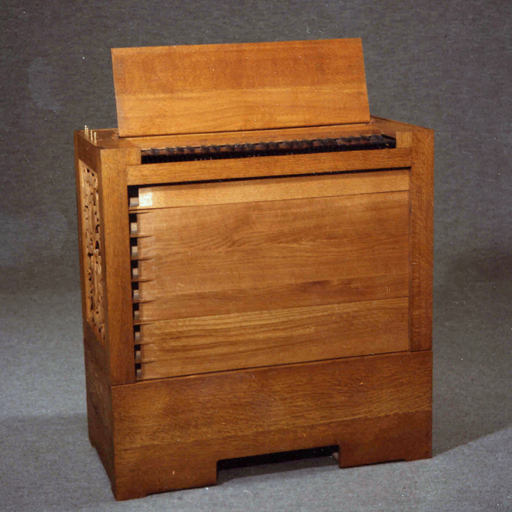
Specialized Organs, small is beautiful
Box Organs
To my mind, a box organ has a special purpose, to accompany or play with a chamber orchestra and/or choir. To do this it must meet specific, often conflicting requirements.
Many of the box organ designs are too bulky and require a truck and four strong men to move. Or they are built tall, like a positiv and block the view. Or they use miniature pipes that are voiced too weakly to be heard doing battle with a chamber group.
Miniature Organs
A church is a large building and requires a powerful musical instrument, such as a pipe organ, that can generate enough musical power to lead massed voices in hymn singing. As well, the organ must have sufficient power to fill the room when playing the organ liturature. But if you move a church organ into a home or practice studio, the pipework and voicing would overwhelm the listener. It would be too darn loud!
At Brunzema's we developed a series of small organs, using special scales and voicing, suitable for smaller spaces. As Brunzema has been dead for 40 years, the firm had no successor, and I was involved with them, I see no harm is sharing some things about them, and the box organ here. The size of these organs was determined by constraints: height by a typical home ceiling, width by the pedalboard, and depth by passage thru a typical room doorway. To save space, the two 8' stops and the pedal 16' shared 17 offset pipes. Space determined the stoplist, explaining the 2-2/3' tg, 2', 1-1/3, 1' stops.
The standardized case split into three horizontal sections, so to fit thru a doorway. The middle section has the keyboards, chests, key and stop action which could be shipped pre-assembled.
Practice Machines
Practice machines present special problems. They must be compact, and soft enough to be played in a small practice studio, for long periods of time. They require two standard, full compass keyboards, plus a standard pedalboard and three couplers: Sw-Gt, Sw-Ped and Gt-Ped. Each keyboard requires at least one independent sound, so you have a minumum of three stops.
However such a minimalist organ is a poor investment. You've paid for two keyboards and a pedalboard, plus the complete actions, chests, wind system, and casework, but you can only use it to practice fingering. It would be better to invest in a few more stops, so that you can actually make music with the organ.

Schools of Organbuilding, a brief history
I spent several summers, back in the late 1970's, organ crawling all over northern Germany and Holland looking at old organs. Many of the historic old organs survived by neglect. Often, they were located in poorer rural areas, where the congregation couldn't afford to rebuild or replace it. Perhaps it was a hand-me-down organ from a richer city church. They survived by poverty; unscathed by rebuilding or replacment by something newer. The church had no idea what they had.
The churches were usually unlocked, and the parishioners proudly encouraged me to violate their instrument to glean its innermost secrets. Often they were amused that anyone would be interested in their old junk. Many of these instruments had already been scaled by others, so I could concentrate on photographs and listening to the organ. I had amazing access, which I shameless exploited. Of course, today these same organs are considered national treasures, have been expensively and meticuiously restored, and are untouchable. They are very difficult to get near, impossible to get to play.
I am not a historian. These are my personal travel notes, plus information given to me from other builders and friends. I also got a lot of information from books (I'm not a scholar, it was for my personal use, so didn't bother to document sources). Finally I filled out some of general information by asking the "DeepSeek" AI; which I shamelessly plagerized (If you copy one source, it's plagerism, if you plagerize many sources, it's an academic liturature search).
The great schools of organbuilding are historically and geographically distinct traditions, each with unique sonic ideals, construction methods, and corresponding bodies of repertoire. There are three great schools of organbuilding, which influence modern North American organbuilding:
- The German Baroque school (e.g. Schnitger 1648-1719, G Silbermann 1683–1753)
- The French Romantic School (e.g. Cavaille-Coll 1811-1899)
- The English Romantic School (e.g. Willis 1821-1901, Wm Hill 1789-1870
It's important to understand that a "school of organbuilding" is inseparable from its corresponding "school of composition" . Composers wrote music that showcased the specific capabilities of the instruments in their region. For example, the large, multi-division organs with prominent pedals in North Germany were essential for the elaborate preludes and fugues of Buxtehude and Bach, while the French Classical organ's unique registration colors were integral to the sound of Couperin's organ masses . These historical styles are not just relics. They form the foundation of modern "eclectic" organs, which aim to combine stops from various traditions to perform a wide range of repertoire .
Historical Summary
Gothic Blockwerk Organs - 14th to the 16th centuries
Gothic Blockwerk Organs - 14th to the 16th centuries
* Key Characteristics: no stops, just a chorus of octaves and fifths like a giant mixture, organ case with
doors, played one note at a time, with the fist on huge keys. None survive, just a couple of empty cases
* Notable Builders: Heinrich Traxdorf - Mid-15th century, Frédéric Schambantz - Early 15th century
* Representative Composers: unknown
Renaissance Builders - mid-15th to early-17th century
During the Renaissance, the first real organs evolved. national schools of organ building also began to emerge. For instance, the classic Italian organ of the period typically had a single manual and was known for its delicate voicing and brilliant, colorful chorus, which included distinctive stops like the voce umana. This contrasts with the powerful, complex instruments being built in Northern Germany at the same time.
German Renaissance Organs - mid-15th to early-17th century
* Key Characteristics: short octave, developed pedal, clear Principal chorus for everyone singing, colourful flutes and reeds
* Notable Builders: Hans Scherer the Elder late-16th, Antonius Wilde 1575–1618, Gottfried Fritzsche 1578–1638
* Representative Composers: Arnolt Schlick 1460–1521, Michael Praetorius 1571–1621, Leonhard Kleber c. 1495–1556
Italian Renaissance Organs - 1550–1650
* Key Characteristics: Small stop-lists focused on principals; no mixtures, individual mutations; principal celeste (rare elsewhere); clear, rich sound
* Notable Builders: Costanzo Antegnati
* Representative Composers: Giovanni Gabrieli, Claudio Merulo, Girolamo Frescobaldi
Spanish Renaissance/Baroque Organs - 1500–1700
* Key Characteristics: Split keyboards for solo/accompaniment textures; horizontal en chamade reeds (trumpets); brilliant, vibrant sound
* Notable Builders: Echevarría family
* Representative Composers: Correa de Arauxo, Antonio de Cabezón, Juan Cabanilles
Baroque Builders - 1600-1750
German Baroque, North - 1600-1750
* Key Characteristics: Werkprinzip (north) with independent manual sections; lean, brilliant choruses
* Notable Builders: Arp Schnitger
* Representative Composers: J.S. Bach, Dieterich Buxtehude
German Baroque, Central - 1600-1750
* Key Characteristics: organs focused on colour
* Notable Builders: Gottfried Silbermann
* Representative Composers: J.S. Bach
German Baroque, South - 1600-1750
* Key Characteristics: fundamental-based sound with gentle voicing. An abundance of 8' registers (flutes, strings like Gamba, Salicional) and colorful mutations,
especially tierce mixtures . Designed for ensemble playing, accompaniment, and blending with instruments/voices, rather than dominating in complex polyphony
* Notable Builders: Joseph Gabler (1700-1771) & Frantz Jacob Späth (1714-1786)
* Representative Composers: Johann Froberger
French Classical - 1650-1770
* Key Characteristics: Abundant mutations, Cornet and bold reeds; specific registrations indicated in titles (Plein Jeux, Grand Jeux);
graceful, elegant sound with complex ornaments (inégalité)
* Notable Builders: Clicquot family, Dom Bédos
* Representative Composers: François Couperin, Nicolas de Grigny, Louis-Clérambault
Romantic Builders - 1830-1930
German Romantic 1830-1930
* Key Characteristics: Focus on blending stops for a rich, symphonic sound; higher wind pressure; crescendo pedal (Rollschweller); reeds blend into tutti
* Notable Builders: GFriedrich Ladegast, Wilhelm Sauer
* Representative Composers: Johannes Brahms, Franz Liszt, Max Reger
French Romantic - 1811-1899
* Key Characteristics: Harmonic flutes, swell box, Barker lever, symphonic sound and performance style
* Notable Builders: Aristide Cavaillé-Coll 1811-1899
* Representative Composers: César Franck, Charles-Marie Widor and Louis Vierne
English Romantic
* Key Characteristics: smooth reeds, Melodia, Tubas, multiple 8' Opens
* Notable Builders: Father Willis 1821-1901, Wm Hill 1789-1870
* Representative Composers: S.S. Wesley (1810-1876), Hubert Parry, Charles Villiers Stanford, and Edward Elgar, Herbert Howells, and Ralph Vaughan Williams

Gothic organs, Blockwerk
The Blockwerk organ represents the first great flowering of organ building in the Western church, a tradition that developed from roughly the 11th to the 15th century. Sadly, none exist any more. Some gothic cases survive in places like Sion (Switzerland), Amiens (France) and Old Radnor in South Wales. Some pipework survives, revoiced and recycled into newer organs.

1370-1400 - Norrlanda keyboard
The Norrlanda Organ (c. 1370-1400) seen above, and Norrlanda's keyboard to the right, is the most well-preserved medieval organ structure in existence. The case and windchest of this organ from Gotland, Sweden, survive. A playable reconstruction can be seen and heard at the Gotland Museum in Sweden. It had an 8 key pedalboard.
Gothic cases
Gothic Architecture comes from the High and Late Middle Ages (12th to 16th centuries). It was characterized by the pointed arch, ribbed vault, flying buttress, large stained glass windows and ornate Details: Gargoyles, spires reaching to the heavens, and intricate stone carvings of leaves and religious figures. Famous Examples: Notre-Dame Cathedral of Paris, Chartres Cathedral, Cologne Cathedral, Milan Cathedral, Westminster Abbey.
Likewise, Gothic organs looked like miniature cathedrals; featuring pointed arches, spires, pinnacles, and tracery that mirrored the building's design. The organ was contained in a single, flat-fronted case. Sadly, most of the survivors shown here have lost there rooftop spires and doors.
Pre-reformation organ cases had doors covering the pipes. During Lent or other somber seasons, closed doors could visually and aurally "humble" the instrument, matching the more restrained mood of the service. The doors would be thrown open for festive occasions like Easter or Christmas. After the reformation the door were often permanantly removed. The cases are remarkably shallow, perhaps a couple of feet deep, and they have only one keyboard. They sometimes have a pedalboard.
Gothic organs were known as Blockwerk organs, a German term meaning "block work," which perfectly describes their construction: a single, unified mass of sound, to support chanting and creating a "wall of sound." This was the age before "stops," when an organ was essentially a single, massive, unchangeable chorus.
What Was a Blockwerk Organ?
Imagine pressing a single key on a keyboard. Instead of one pipe sounding, a whole group of pipes would speak at once. This was the essence of the Blockwerk. There were no stopknobs, no choice; the organ had no means of selecting individual sounds. This fixed combination is essentially a single, giant mixture stop that was always on. The sound was brilliant, loud, and powerful, designed to fill vast stone churches with a wall of sound.
The composition of this "block" could vary. A small Blockwerk might consist of just 8', 4', 2' pitches. A larger one could be 8', 4', 2-2/3', 2', 1-1/3'. The most magnificent examples might include 16', 8', 5-1/3', 4', 2-2/3', 2', 1-1/3', 1'. At first, the inclusion of the fifth-sounding 5-1/3' was not seen as a harmonic problem, as music was often monophonic (one note at a time). But as music became sophisticated, the 5-1/3' was often omitted to avoid parallel fifths and 16' resultants.
In the Romanesque (c. 1000-1200), there were smaller Blockwerks with fewer ranks. It could include a quint rank (e.g., 5 1/3'), creating a sound that worked for parallel organum, an early form of polyphony where a voice moved in parallel fourths or fifths. Supporting and reinforcing the monophonic chant and early experimental polyphony.
By the Gothic period (c. 1200-1400), Blockwerks grew significantly in size. The 5-1/3' rank was often removed, as it clashed with the harmony of true independent polyphony. Higher ranks were often "multipled," meaning there were several pipes for the higher pitches, increasing brilliance. Accompanying and inspiring the development of complex vocal polyphony.
Stop Control
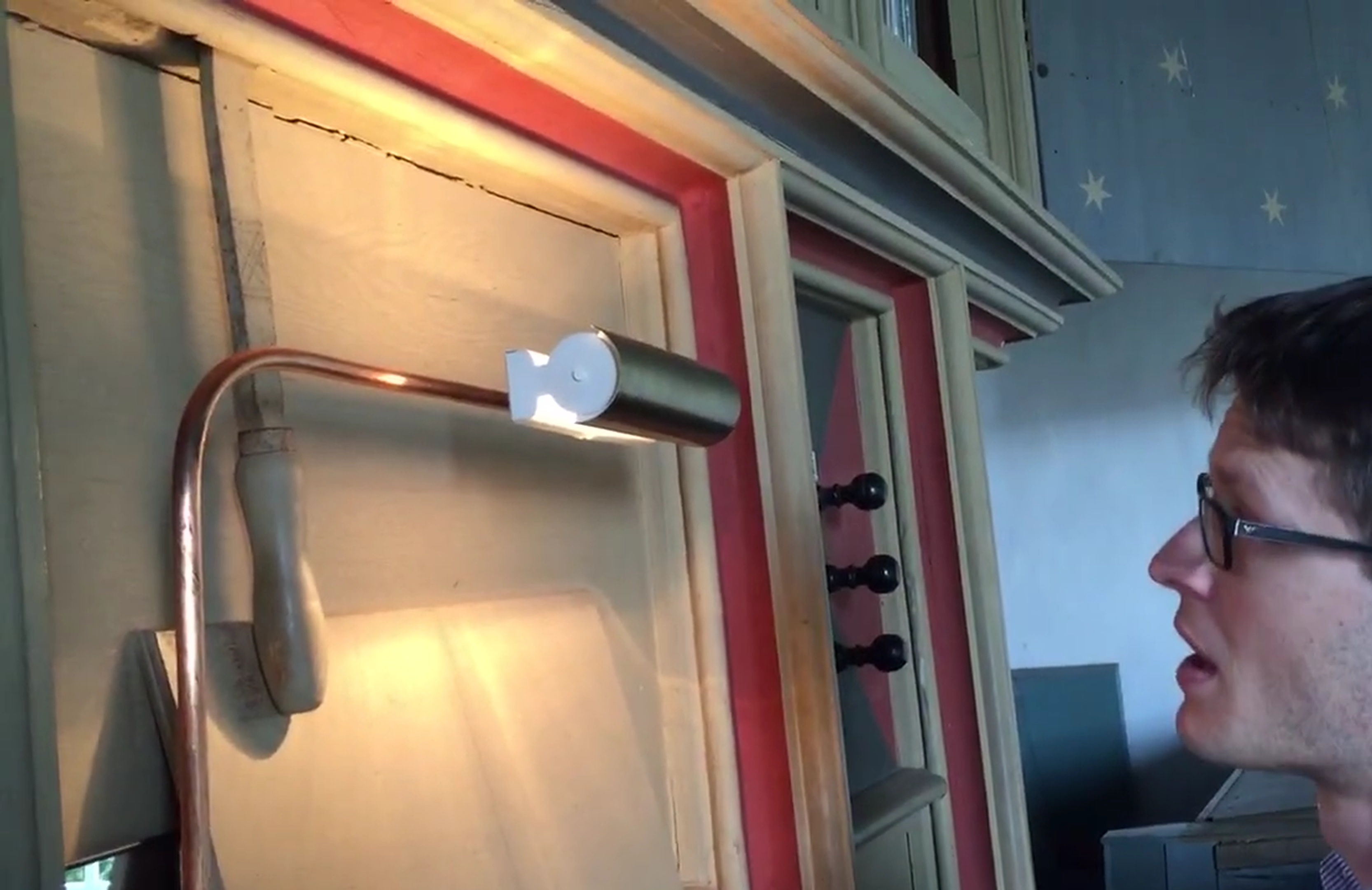
The fixed Blockwerk presented a limitation: you couldn't change the sound. The desire for more variety led to the first, crucial innovations that paved the way for the modern organ. The Spring Latch Chest (Sperrventillade): The first breakthrough was dividing the windchest. Organ builders began to split the Blockwerk into two or more sections, each with its own valve that could be turned on or off. This was the first primitive form of registration.
The first division often separated the front pipes (the Praestant or Principals in the facade) from the inner pipes. You can see that at Rysum, with that lever sticking down from the impost, in front of the music rack (see photo at right).
The second division might separate the higher-pitched pipes (the Hintersatz, or "back set") from the main body. By the late Middle Ages, builders started to "split" the Blockwerk further, using mechanisms that allowed the organist to draw individual ranks of pipes. This was the birth of the register. For instance, the Praestant division could be split into an 8' Principal and a 4' Octave. The Hintersatz could be split into a multi-rank Mixture and a high-pitched Cymbel . This evolution, happening from the 15th century onward, gradually transformed the monolithic Blockwerk into the "register organ" of the Renaissance .

1435 - Sion, Switzerland
Valeria Kirche of Sion Switzerland has an organ whose case dates to about 1435. Many of the original pipes still exist in the existing organ. There is also a wooden Coppel 4', dated (dendrochronology) to 1390. I presume it was added during the 1687 rebuild, because what is the point of a 4' Flute in a blockwerk?
Judging from surviving pipes, it's original blockwerk was probably 8', 4', 3', 2', 1-1/3', 1' and 1/2'. In 1687 Christoph Aebi rebuilt the instrument, adding several stops and expanding the keyboard while keeping the original case. He also added stop control, breaking the blockwerk into individual ranks. Because of frequent revoicing and rebuilding over the centuries, we have no idea what it originally sounded like. Even the case has been modified, and those dreadful, hugh Bourdon pipes were added, behind the organ.
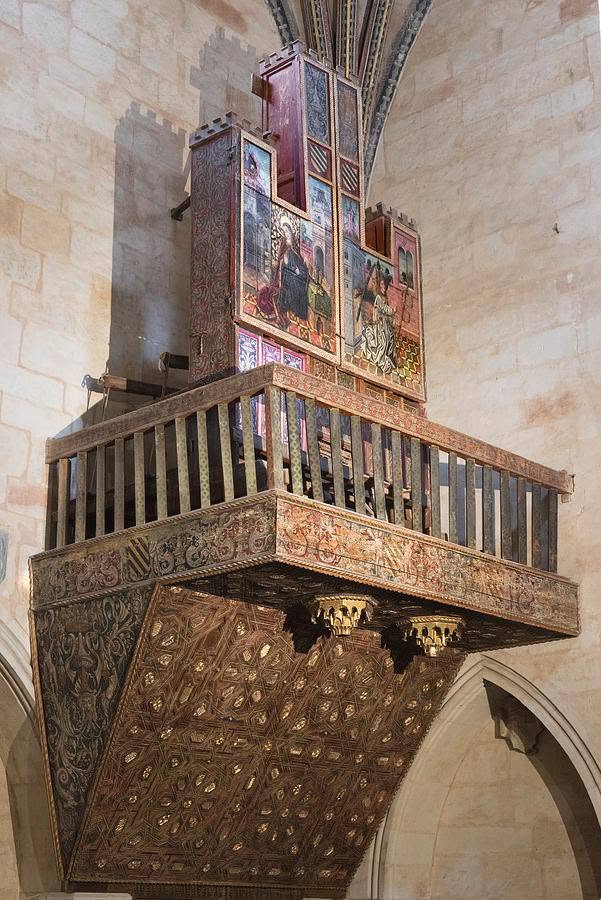
1400's - Salamanca Cathedral, Chapel of Anaya
This is the oldest of the organs, dating back to the 15th century, making it one of the oldest surviving organs in Spain and Europe. While it no longer contains its original pipes or sound-producing material, it retains many of its mechanical parts, which provide valuable insight into its original function and sound.
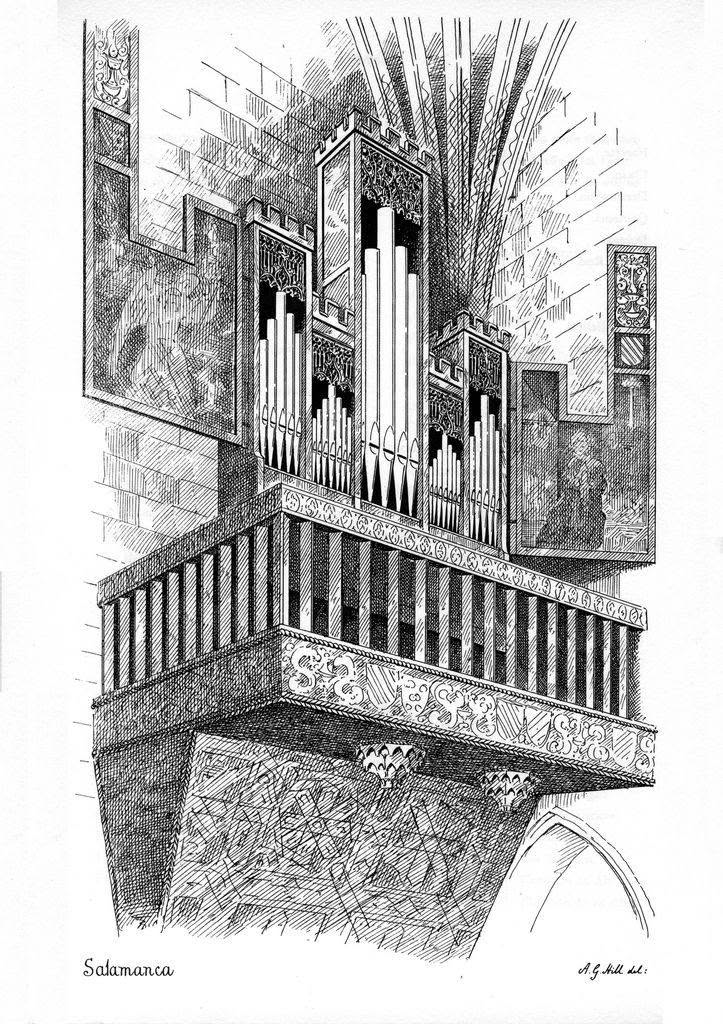
Its case, adorned with a painting of the Annunciation, is a significant artifact in its own right. Arthur George Hill (1857-1923) was the head of the firm William Hill & Sons and a respected authority on the history of organs and Spanish architecture.
He is known to have made detailed drawings of the historic organs in the Old Cathedral, particularly the Salinas Organ. Records indicate that a drawing (see drawing at left) of the Salinas organ by Arthur Hill was an important reference used during its reconstruction in 1985.
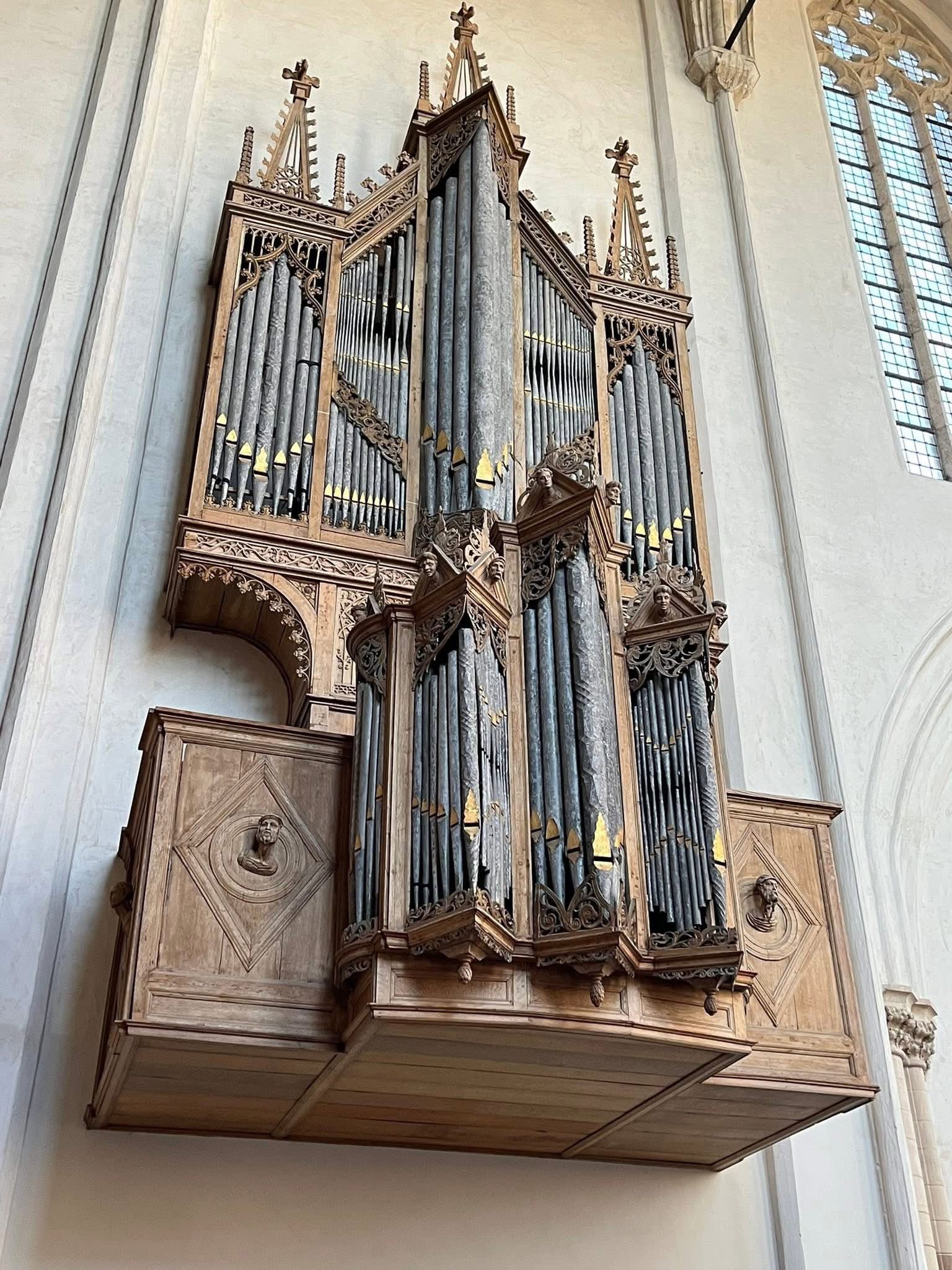
1479 Gothic/Renaissance Organ, Middelburg Kookerk
The organ in the Middelburg Koorkerk has a world-famous, 15th-century organ case, with a 1969 modern organ inside it. The 15th-Century Historic Organ Case was build between 1478 and 1481 by Peter Gerritsz from Utrecht, making it the oldest surviving organ case in the Netherlands.
The main case is late-Gothic. A tower in the center of the traditionally flat Gothic front, accomodates the large 8' Principal pipes, that wouldn't fit inside the shallow case. This innovation of towers became a common design feature of Baroque organs. The "rugwerk" (choir organ) section was added around 1560 in a Renaissance style. Originally built for the Nicolaïkerk in Utrecht. After various moves, the case was loaned to the Koorkerk in 1952.
(Photos from Léon Berben’s Facebook Page.)

1500's - Old Radnor, Powys Wales
To the left you can see the early 16th Century case at St Stephen's Church, Old Radnor, Powys Wales. This case is the oldest in England, built just at the transition from gothic to renaissance designs. Only the case remains; chest, keyboard, action, pipes and bellows are all lost. Sutton had a new organ built (1871) inside the old case, though he tried to preserve the old case. The biggest pipe in the facade is an 8' F (6' organ.
The case is 5 meters high, 3 meters wide but only 800 mm deep, showing the gothic preference for shallow cases. There was evidence of several primitive stop actions, huge side levers that could be moved by the bellows pumper. Sutton (1871-rebuilder) claimed there was evidence of 5 stops though there is space for more.

Renaissance Organs mostly Dutch/North German
Some of these Renaissance organs have older dates than the Gothic organs. That is because the date refers to the casework and perhaps some of the pipes. Because the organ has been rebuild in the renaissance style, that is it's classification. Most organs get rebuilt every 50-100 years, so these old organs could have been changed many times. (Photo is the 1624 Scherer-Organ in Tangermuende, Germany.)
Many Gothic and Renaissance organs were "F" organs. The compass of the keyboard went from F to A above, with a range of about +3 octaves. These organs were for accompanying human singers, and F to A above was the range of the human voice. An F compass means the biggest pipe in the facade is 6' long. Most of the facades in gothic and renaissance organs are 6' (or 12').
Later rebuilding usually resulted in the keyboard compass rebuilt as "c". Using a short-octave bass "F" keyboard was a simple way of fitting new "c" compass organ chest and pipes, into a preexisting "F" compass casework. You need fewer big pipes, and have a shorter keyboard which would fit the existing space.
An F compass means that the biggest pipe in the facade is a 6' pipe, (an F). Large organs with a sub-octave would have a 12' as the biggest pipe in the facade. I find 12' cases to be very balanced and proportionate. Eight foot cases look somewhat squat, and the big pipes of a 16' case oversized. See the photo of the Father Smith organ, Great St Mary's in Cambridge, 1698, with a 12' facade.
Of course, a C compass keyboard, with a 6' facade could simply mean coping with a low ceiling...

These organs often had a short octave in the bass. You rarely play the # (black) notes in the bottom octave, they are omitted, to save space and cost. There are several variants. In this example, F played the C pipe, F# played D, G played E, G# played F, A played G, A# played A, B played B. From tenor C, the rest of the keyboard was normal.
Evolution, from Blockwerk to Baroque
Renaissance organbuilding was the process of experimentation and innovation, as the organ evolved from the primitive Gothic blockwerk organ, to become the mature German Baroque organ. There were several key innovations developed during the Renaissance:
1) Incorporating towers in new designs; the gothic facades were usually flat.
2) The disaggregation of the blockwerk into individually controlled stops.
3) The Pedal was expanded from a pulldown pedalboard, perhaps with a single octave of Tromps (Bourdons), to become a complete division with a standalone chorus. Instead of just being a bass drone, it could now carry it's own voice in the polyphony.
4) Addition of a second keyboard with a contrasting chorus, and with the improved Pedal; you could now do Trios. You can do "call and response" music between the keyboards.
5) Invention of new stops, especially solo voices: Trumpet, Gedakt, Quintadena, KrumbHorn, various regals, dramatically increased the musical choices...
6) Hintersatz broken down into a new style of breaking mixtures, leading in some organs, to a subtle vocal-like color from the mixtures, clarifying the polyphony.
The first five innovations are obvious. But If you aren't familiar with the concept of "vocal" organs, or would like my thoughts about Mixtures, click on the Mixtures button below.

1457 - Rysum, Germany
Rysum, Germany (Ostfriesland) – Dorfkirche. Built by an unknown builder 1457. One of the oldest organs in Germany. Enlargement 1513. Restauration plus reconstruction Sesquialtera, Mixtur and Trompette by Ahrend and Brunzema 1961. The panels with a crescent moon and the sun, removed in 1737, have been reconstructed. No pedal. Pitch circa a’= 440 Hz. Tuning modified Meantone. Manual compass: CDEFGA - g''a''.
- Praestant 8'
- Gedackt 8'
- Octave 4'
- Octave 2'
- Sesquialtera II
- Mixtur III-V
- Trompette 8'
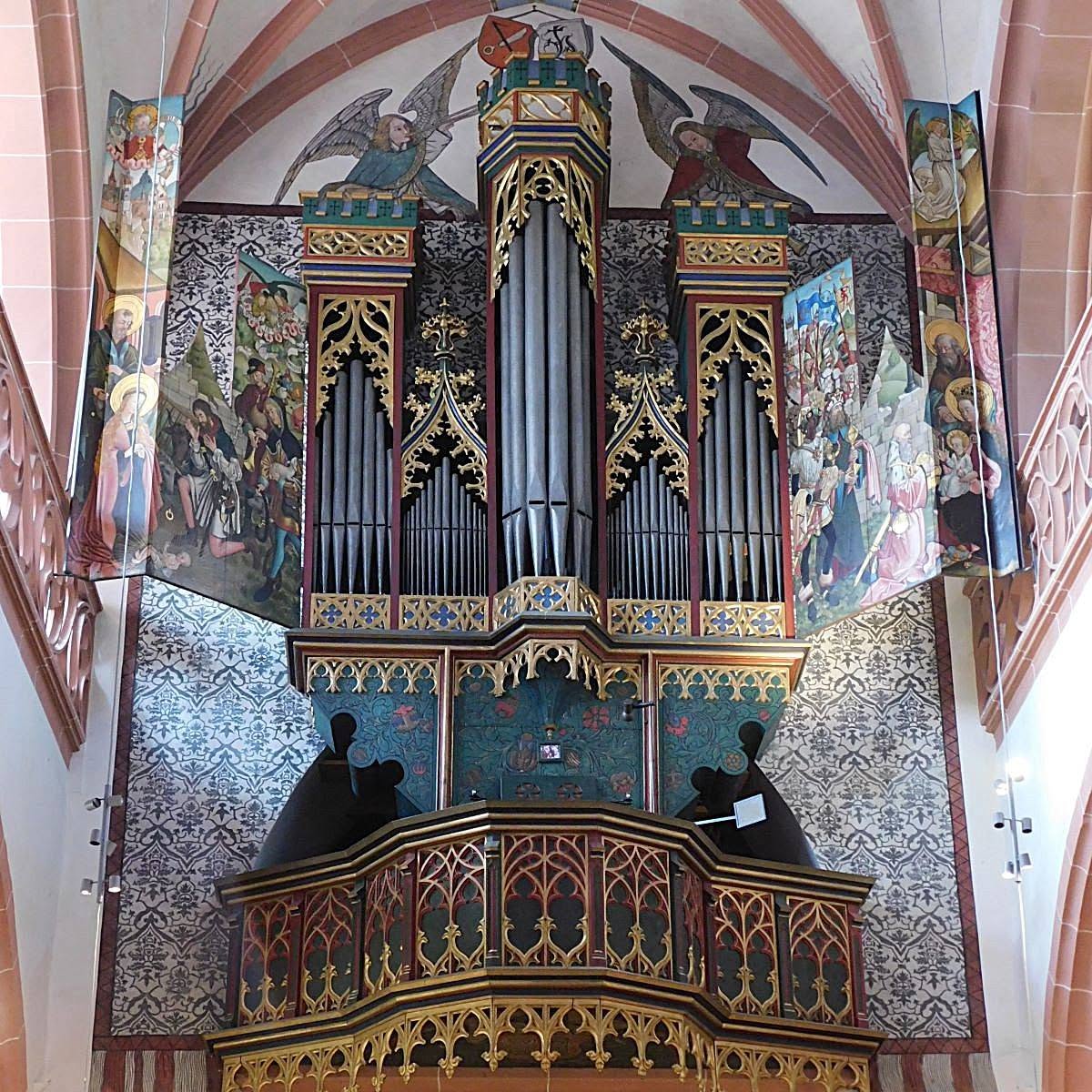
~1500 - Church of St. Valentine and Dionysius, Kiedrich, Hessen
The organ in the Church of St. Valentine and Dionysius in Kiedrich, Hesse, is one of Germany’s oldest playable organs, with its origins around 1500. It was built as a single-manual instrument in a swallow's nest position, by an unknown master.
The instrument was modified over the centuries. In 1653 it was rebuilt by Johann Wendelin Kirchner, who later added a small Positif division. In 1722, an independent pedal system was added.
By 1800, it had fallen into disrepair. It was rescued in 1857 by Belgian builder August (Louis-Benoit) Hooghuys, funded by English baronet Sir John Sutton to bring it back to its 1500 aesthetic. The most recent restoration (1985–1987) by Orgelbau Kuhn returned to its Sutton-era condition.
It has approximately 960 pipes, about 80% and 90% of its case are original. Its historical meantone temperament is best suited for music from the Gothic, Renaissance, and early Baroque periods (not the later works of Bach).
Hauptwerk (II), as at 1987 condition
- Großgedackt 16'
- Principal 8'
- Octave 4'
- Flötengedackt 4'
- Quinte 2 2/3'
- Octave 2'
- Mixtur IV 1 1/3'
- Cymbel II 1/2'
Positiv (I)
- Gedackt 8'
- Principal 4'
- Flöte 4'
- Waldflöte 2'
- Quinte 1 1/3'
- Superoctave 1'
- Mixtur IV 2'
Pedal
- Subbaß 16'
- Principal 8'
- Doppelquinte 5 1/3'
- Octave 4'
- Quinte 2 2/3'
- Superoctave II 2' + 1'
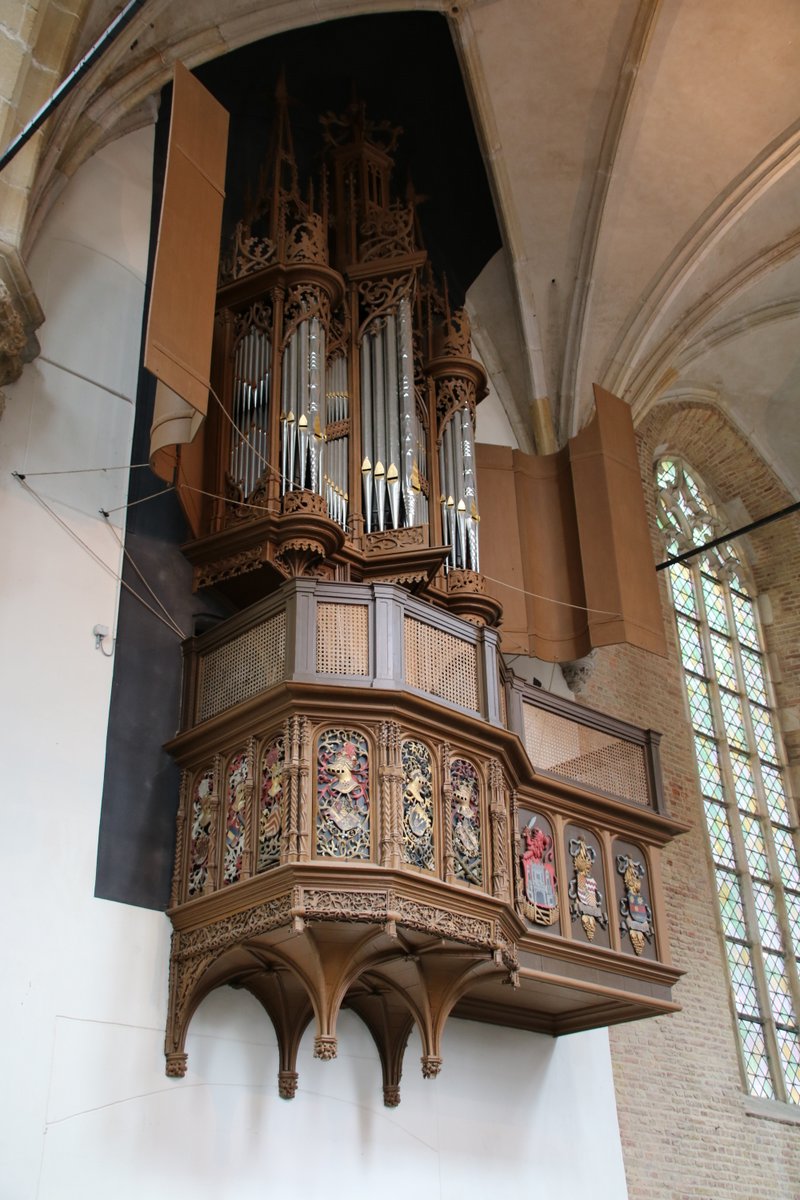
1511 - Alkmaar, Sint-Laurenskerk Koororgel
Built in 1511 by Jan van Covelens, this instrument holds the distinction of being the oldest playable organ in the Netherlands. While it has undergone several restorations over the centuries, the most recent major restoration (completed in 2000 by Flentrop Orgelbouw) successfully preserved its historical character and sound. It is positioned against the north wall of the church.
Keyboard compass is FGA–g"a" (short octave, missing G#/Ab); Pedal FGA–c' (missing G#/Ab and D#/Eb). Borstwerk is later 17th-century material. Pitch: a' = 427 Hz
- Stoplist - 2000
- Doof 8'
- Holpijp 8'
- Koppeldoof 4'
- Openfluit 4'
- Sifflet 1-3/5'
- Mixtuur II-VI ranks
- Scherp III-VI ranks
- Trompet 8'
- Borstwerk (17th-century material)
- Quintadeen 8'
- Fluit 4'
- Octaaf 2'
- Octaaf 1' (discant)
- Pedaal
- Trompet 8'

1521 - Oosthuizen
The "Oosthuizen old organ" refers to a historic pipe organ in the Reformed Church (Grote Kerk) in Oosthuizen, a village north of Amsterdam in the Netherlands. It is considered one of the oldest playable organs in the world and one of the best-preserved instruments from the 16th century in Northern Europe . Originally, this was a 6' organ starting at F.
While the organ is often dated to 1521 (the same year the church was completed), the exact origins are mysterious. The instrument is believed to be an amalgamation of parts from even older organs, possibly dating back to the 15th century. A document from 1548 confirms an organ existed at that time, and a later 17th-century restoration likely added some of the current stops.

Of special interest is the short-compass keyboard, starting on F. That is a simple way of fitting new "c" compass organ chest and pipes, into a preexisting "F" compass casework. It is a modestly sized instrument with a single manual (keyboard), no pedals, and (today) with just seven stops.
- Bourdon 16′
- Praestant 8′
- Octaaf 4′
- Quint 2 2/3′
- Woudfluit 2′
- Sexquialter II
- Mixtuur II-III
- Tremulant

1531 Kreward, Groningen
Built in 1531 by an unknown builder. It is the second-oldest playable pipe organ in the entire Netherlands (the oldest is from 1511 in Alkmaar). It is housed in the Mariakerk (Mary's Church), a medieval village church in Krewerd, a small village in the municipality of Eemsdelta with a population of around 75.
- Stoplist - 1972–1975
- Praestant 8' (façade)
- Holpijp 8'
- Octaaf 4'
- Fluit 4'
- Octaaf 2'
- Sesquialter II (discant)
- Mixtuur III–IV

1610 - Frederiksborg Castle, Hillerod
The organ of the chapel of Frederiksborg Castle, Hillrod was built in 1610 by Esaias Compenius. Hillerod is a virgin, but it is a freak organ built for secular purposes for a Royal castle. It is built using unusual materials (ivory and ebony) and all the pipework is wooden. The organ is also a visual treasure. The exterior features intricate carvings by the master craftsman Herman van de Velde, and the visible facade pipes are covered in ivory and ebony, giving the instrument a truly regal appearance . Stop names are abbreviated (using the upper case letters in the names as stated above: GP, GGF etc.) manual compass: C, D, E, F, G, A-c'''. pedal compass: C, D, E, F, G, A-d'. The organ's construction dictates its unique voice. Because the pipes are wooden, the sound is often described as exceptionally soft, gentle, and "velvety" —a perfect representation of Renaissance musical ideals
- Stoplist (original)
- Overværk
- Gross Principal 8'
- Gross Gedact Flöite 8'
- Klein PrinciPal 4'
- GemsHorn 4'
- NachtHorn 4'
- PlockFlöite 4'
- Gedact-Quint 3'
- Kleine Flöite 2'
- R.Rancket 16'
- Tremulant*
- Positiv
- QuintaDehna 8'
- GedactFlöite 4'
- GemsHorn 2'
- NaSatt 1 1/2'
- Zimbel I
- PrinciPal Cantus 4'**
- BlockFlöite Cantus 4'**
- KrumbHorn 8'
- Klein Regal 4'
- Tremulant*
- Pedal
- GedactFlöiten Bass 16'
- GemsHorn Bass 8'
- QuintaDehn Bass 8'
- QuerFlöiten Bass 4'
- NachtHorn Bass 2'
- PaurFlöiten Bass 1'
- Sordunen Bass 16'
- Dolzian Bass 8'
- Regal Bass 4'
- Tremulant*
- * common canal tremulant for manuals; strong tremulant for pedals.
The Compenius organ was built c. 1610 at the request of the Duke Heinrich Julius of Braunschweig-Wolfenbüttel, a remarkable intellectual leader who was a pioneer in several areas including theatre management, newspaper publication and organ building. The idea behind this unusual instrument was primarily to demonstrate how far the art of organ building had progressed, and how many beautiful, subtle sounds could be produced solely from wooden pipes.
The duke had chosen one of the leading organ-builders of the time, Esaias Compenius, to carry out the task, and he summoned his court organist, the composer and musical theoretician of many talents, Michael Praetorius, to act as a consultant. After Heinrich Julius's death the instrument was given to his brother-in-law, the music-loving Danish king Christian IV for is chapel at Frederiksborg Castle, Danmark.
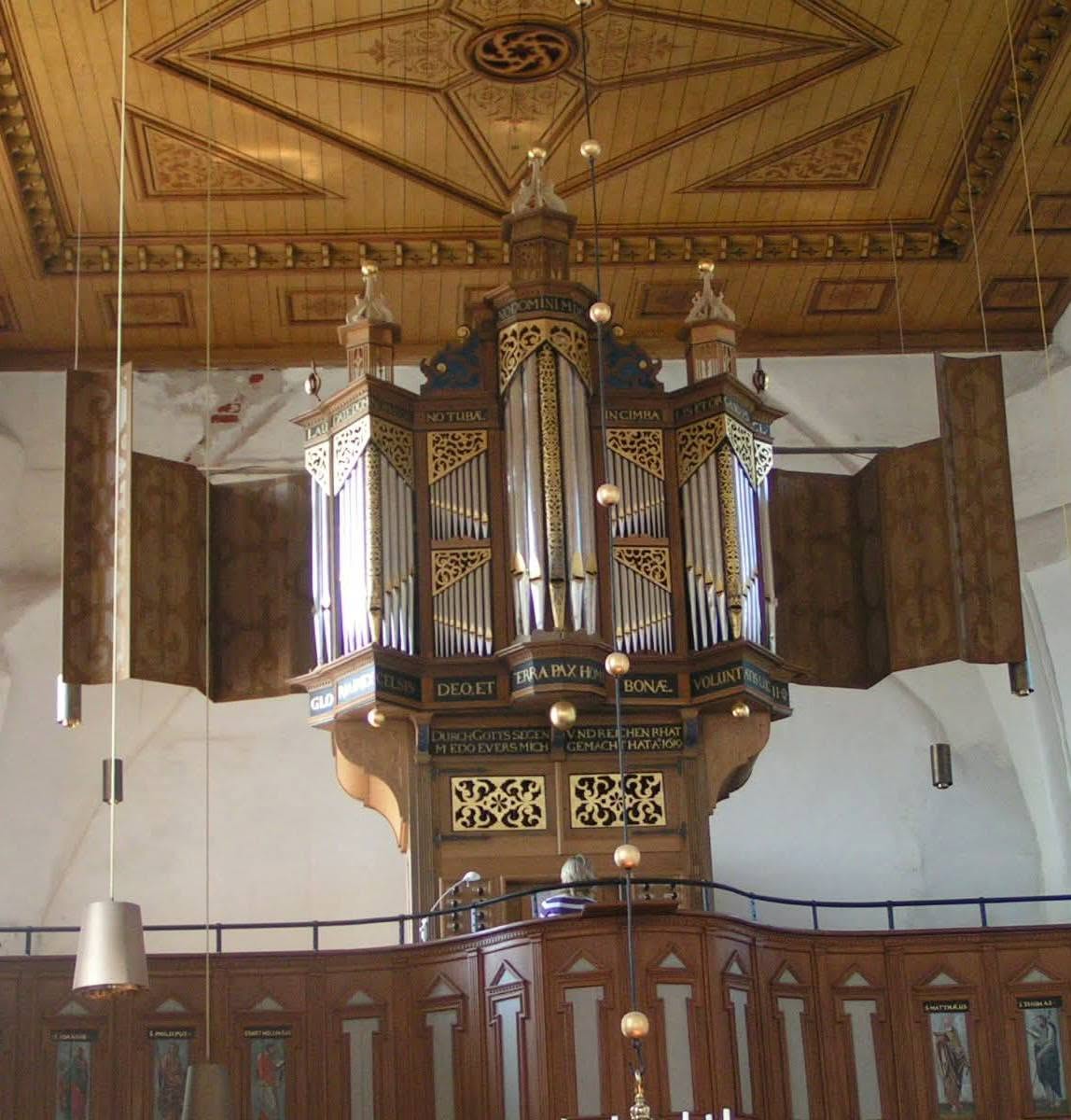
1619 Osteel, North Germany
Renaissance organ in Warnfried Church, Osteel, Northern Germany. It was built by Edo Evers in 1619, who incorporated some even older pipe material from a previous instrument made by Andreas de Mare between 1566-1567 .
The organ was meticulously restored in 1994-1995 by Jürgen Ahrend, who returned the instrument to its original Renaissance sound and visual appearance. During this work, only the Mixtur (mixture stop) had to be recreated. The organ has 13 registers (stops) across two manuals (Hauptwerk and Brustwerk), and has a Pedal that is permanently attached to the manuals.
Hauptwerk as at 1995
- Quintadena 16'
- Principal 8'
- Quintadena 8'
- Octave 4'
- Spitzflöte 4'
- Quinte 3'
- Octave 2'
- Mixtur IV
- Trompete 8'
Brustwerk
- Hohlflöte 4'
- Spitzflöte 2'
- Sifflöte 1'
- Krummhorn 8'
- Pedal permanently attached to the manuals
- Accessories: Tremulant, II/I coupler
- Three wedge bellows, 70 mm wind pressure
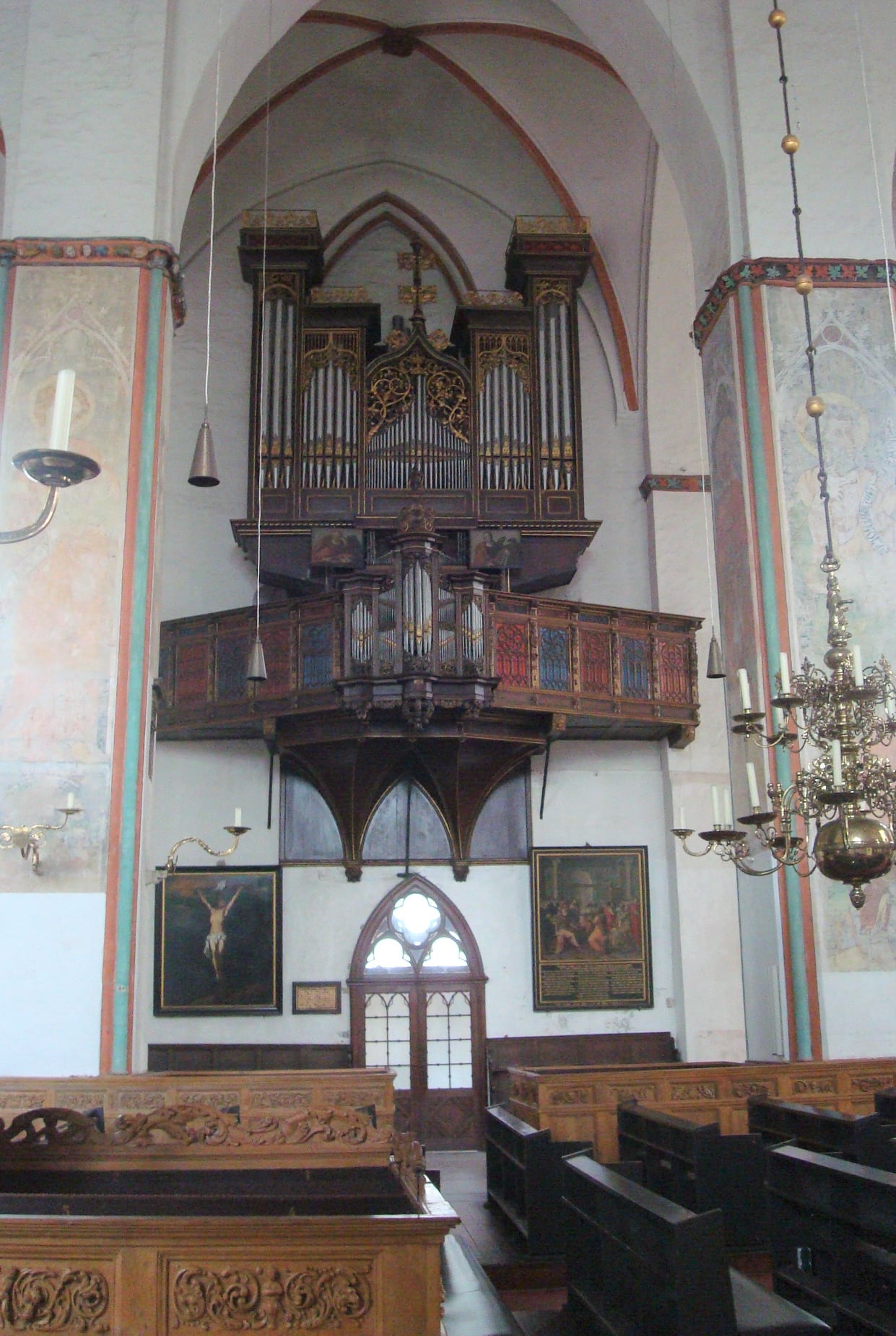
1467-1636 Stellwagen Organ at St Jacobi in Lübeck
The Stellwagen Organ at St. Jacobi (St. Jakobi) in Lübeck is one of the world's most significant surviving examples of North German organ building, known for its rich history and preserved Renaissance and Gothic pipework. The organ is known as the "Kleine Orgel" (Small Organ) to distinguish it from the larger organ in the church.
The organ's case dates back to a Gothic organ built in 1467. In 1636/37, the renowned organ builder Friedrich Stellwagen extensively rebuilt and expanded it into a three-manual instrument, adding the Rückpositiv, Brustwerk, and pedal divisions. It is one of only two surviving organs by Stellwagen, the other being in Stralsund.
It has preserved a significant amount of its original Gothic and Renaissance pipework, making it very rare. It survived World War II largely unscathed, unlike many other Lübeck instruments. The Rückpositiv and Brustwerk stops are largely from Stellwagen's original 1637 work, while the Hauptwerk retains many Gothic pipes. The Pedal division was updated significantly in 1978 by Gebrüder Hillebrand.
The organ is closely associated with composer Hugo Distler, who worked at St. Jakobi in the 1930s and initiated its restoration. It remains a central instrument for performing the North German organ repertoire of composers like Dieterich Buxtehude.
Hauptwerk II
- Principal 16'
- Octave 8'
- Spillpfeife 8'
- Octave 4'
- Nasat 2 2/3'
- Rauschpfeife II
- Mixtur IV
- Trompete 8'
Rückpositiv I
- Gedackt 8'
- Quintadena 8'
- Principal 4'
- Hohlflöte 4'
- Sesquialtera II
- Scharff III-IV
- Krummhorn 8'
- Trechterregal 8'
Brustwerk III
- Gedackt 8'
- Quintadena 4'
- Waldflöte 2'
- Zimbel II
- Regal 8'
- Schalmei 4'
Pedal
- Subbaß 16'
- Principal 8'
- Spillpfeife 8' (from Hauptwerk)
- Octave 4'
- Gedackt 4'
- Flöte 2'
- Rauschpfeife IV
- Posaune 16'
- Trompete 8' (from Hauptwerk)
- Trompete 4'
- Regal 2'
Tremulants for the Hauptwerk/Brustwerk and Pedal, as well as couplers: Hauptwerk-Rückpositiv, Hauptwerk-Brustwerk, and Pedal-Hauptwerk. The organ is tuned in Werckmeister III temperament at a pitch approximately a whole tone above modern concert pitch (a1 = 440 Hz).
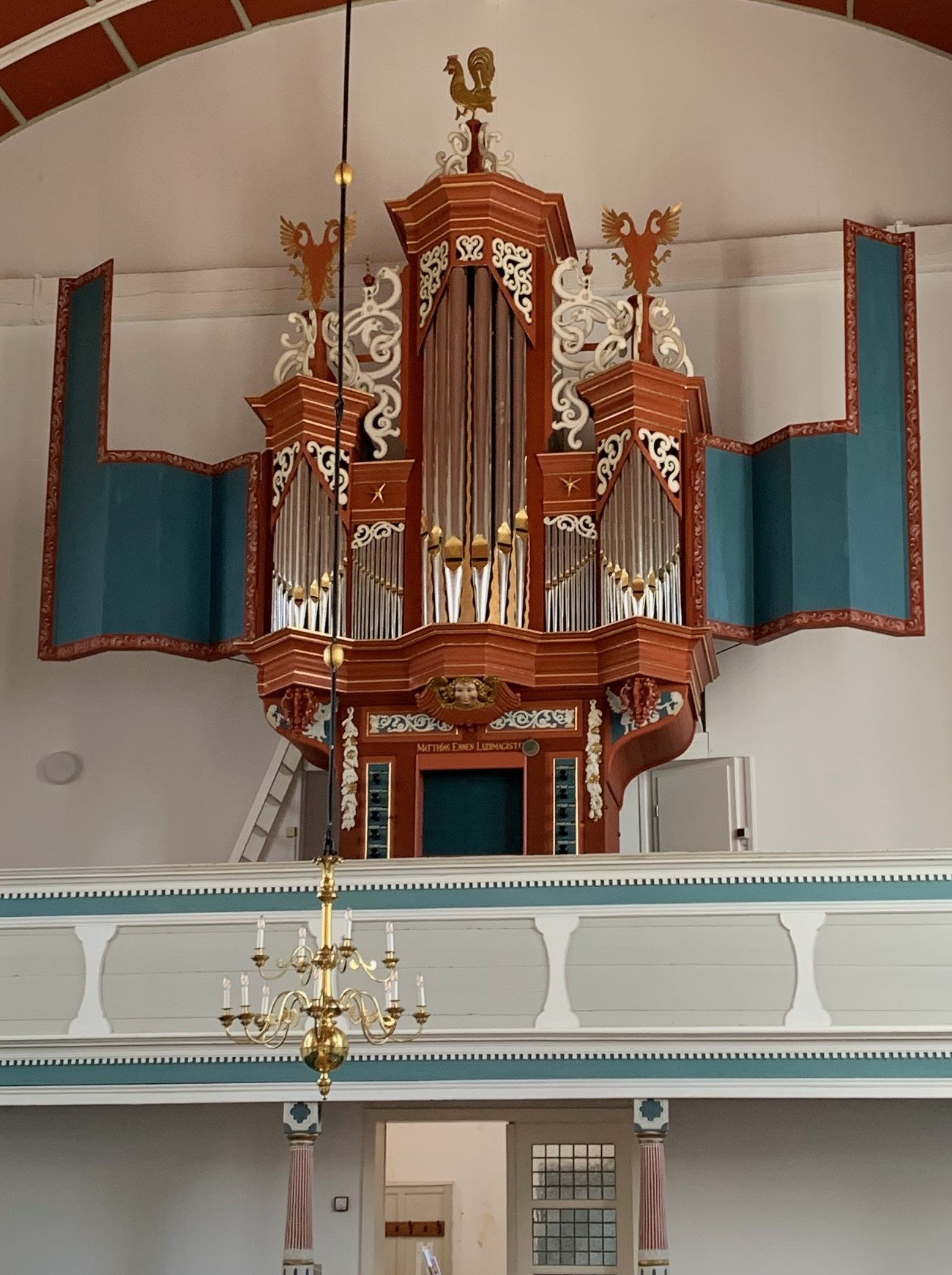
1655 Uttum, Ostfriesland
Built in 1655 by an unknown builder. Uttum Church, Ostfriesland, Germany, in Evangelical-Reformed Church, Uttum, East Frisia, Germany. It currently has 1 manual (CDEFGA-c''') and 9 registers.
It was restored in 1956-57 by Ahrend & Brunzema and Ahrend 2020. Ahrend & Brunzema recreated only two registers (the Praestant and Sesquialtera). It was likely constructed using even older pipe material, with some pipework possibly dating back to the Late Gothic period.
Stoplist - as at 2020
- Quintadena 16',
- Principal 8'
- Gedakt 8'
- Quintadena 8'
- Octave 4'
- Octave 2'
- Sesquialtera II - 1957
- Mixtur III-IV
- Trompete 8'
- Tremulant
- Cimbelstern
The organ is a pure example of the Renaissance musical ideal: it embodies the "vocal" sound ideal of the Dutch Renaissance masters, favoring a clear, blend-focused tone rather than the powerful, soloistic sounds of later Baroque organs.
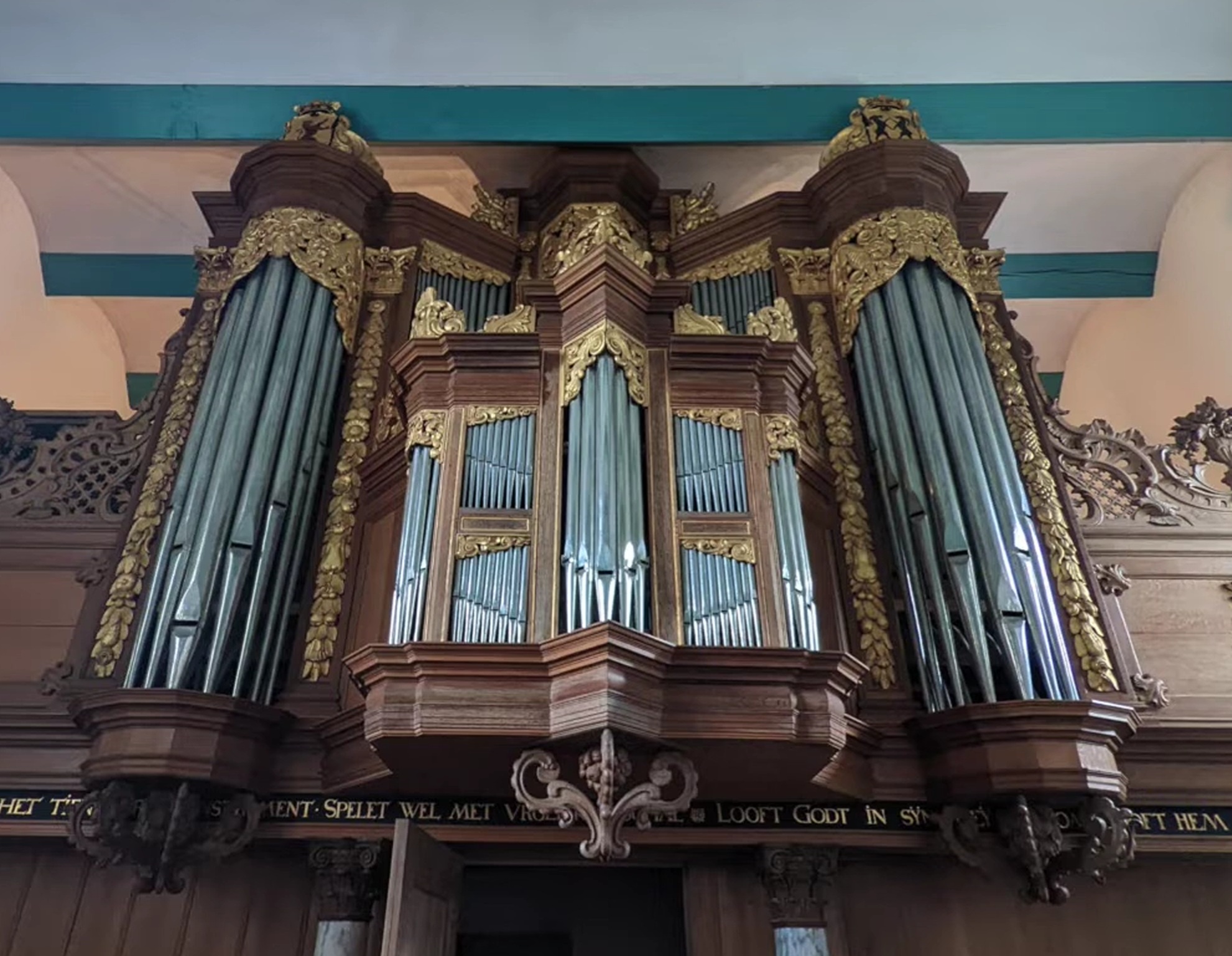
1664 Huis organ in Kantens
The organ in Kantens was built by the renowned Hendrick Huis (or Heinrich Huß), a master organ builder from Oldenburg who was active in Groningen. The instrument is located in the village's Reformed Vituskerk.
The organ of the Antoniuskerk in Kantens has a very special place in the rich organ heritage of the region around Groningen. Originally built in 1664 by Hendrick Huis ("Hoofdwerk"), it was expanded in 1668 with a "Rugwerk" by Johannes Huis. The organ is very well suited to manual organ repertoire from the late Renaissance to the High Baroque, bringing to life not only Dutch music, but also works from most 17th century European styles.
The restoration of the "Hoofdwerk" by Jürgen Ahrend (1986) and the reconstruction of the ''Rugwerk" by Hendrik Ahrend (2007), both in collaboration with Cor Edskes, are exemplary. Because it has been restored to its original 17th-century specifications and has survived many trials, organologist Cor Edskes jokingly called it a "North German organ in a pocket format".
Timeline of the Organ
- ~1660 Hendrick Huis builds the original organ.
- ~1667/70 The organ is expanded by his brother, Johannes Huis, who adds a Rückpositiv.
- 1817 The church's patron goes bankrupt, and the organ is dismantled and stored. The sale is reportedly prevented by King William I.
- 1822 Johan Wilhelm Timpe carries out a partial, low-cost reconstruction, but only rebuilds the Hauptwerk.
- 1954 The organ is removed again during church restoration and stored in the rectory and fire station.
- 1986 Jürgen Ahrend completes the first phase of a major restoration. He restores the Hauptwerk, largely using the original pipework.
- 2007 Ahrend completes the reconstruction by rebuilding the Rückpositiv division with new pipes, based on historical models.
Hoofdwerk - as at 2020
- Prestant 8'
- Bordon 16'
- Holpijp 8'
- Octaave 4'
- Quint 3'
- Sup. Octave 2'
- Sieffluit 1½'
- Sexquialter
- Mixtuir
- Trompet 8'
- Tremulant
Rugwerk
- Quintadena 8'
- Fluijt 4'
- Prestant 2'
- Cimbel
- Regaal 8'
Other Stuff
- Koppels - HW+RW
- Pedal (21 notes) permanantly coupled to hoofdwerk
- Compass CDEFGA-c''', (2 x 45 notes)
- Pitch a'=450.6 Hz @ 15 Celsius.
- Tuned in the pure meantone temperament with eight pure thirds, quarter-comma meantone.
Sexqualter II
- C 1⅓' - ⅘'
- c 2⅔' -1⅗'
Mixtuur IV-VI
- C: 1' - ⅔’ - ½’ - ⅓’
- c: 2' - 1⅓’ - 1' - ⅔’
- c’: 2⅔' - 2' - 1⅓’ - 1' - ⅔’
- f': 2⅔' - 2' - 1⅓’ - 1' - 1’
- c'': 4' - 2⅔’ - 2' - 1⅓’ - 1' - 1'
Listen to Huis Organ (YouTube),1660 »
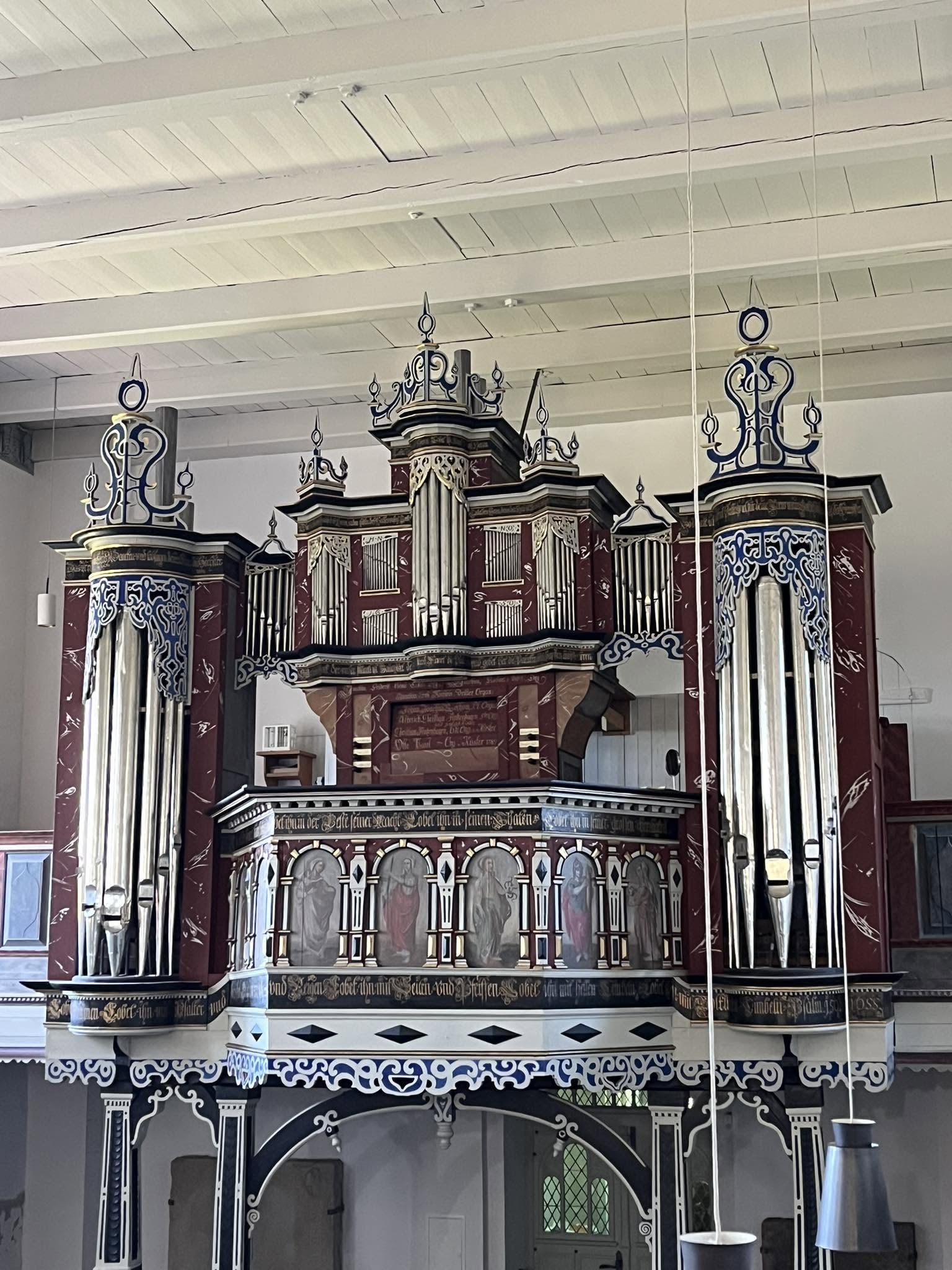
1650 Langwarden St. Laurentius, Orgel von H. Kröger
The Kröger organ in St. Laurentius, Langwarden, built in 1650-51, provids a direct link between the renassance and Baroque. The organ was a collaborative effort between the master organ builder Hermann Kröger and his journeyman, Berendt Hus. This workshop is highly significant in organ history, as Berendt Hus later became the master and teacher of the legendary organ builder Arp Schnitger. The organ in Langwarden is one of the few surviving instruments from this important workshop and represents a foundational point for the famous Schnitger style.
This organ is especially notable for containing its original Springladen (spring wind chests). This is an early and innovative stop control, using key channels, plus individual stop pallets for each pipe. This bulky and complicated windchest ensures a steady and even wind supply, contributing to the organ's clear and vocal tone. However, the much simpler and compact springlade (slider chest) design was soon succeeded as standard in newer organs.
The organ has two manuals and a pedal (II+P) with 21 stops. While 14 of the original stops survive, the organ has undergone a series of careful restorations to maintain its historical character. The most recent major restoration, completed in 2015 by Hendrik Ahrend, reconstructed the missing mixtures and reed stops.
Disposition of the Kröger Organ (1650/51)
Hauptwerk
- Gedackt 8'
- Quintadena 8'
- Praestant 4'
- Spitzflöte 4'
- Scharf Quint 3'
- Oktav 2'
- Nasat Quint 1 1/2'
- Mixtur 3f
- Trompete 8'
Brustwerk
- Gedackt 8'
- Blockflöte 4'
- Schweizerpfeife 4'
- Oktav 2'
- Cimbel 2f
- Krummhorn 8'
Pedal
- Untersatz 16'
- Praestant 8'
- Oktav 4'
- Bauernflöte 2'
- Posaune 16'
- Untersatz 16'
- Praestant 8'
- Oktav 4'
- Bauernflöte 2'
- Posaune 16'
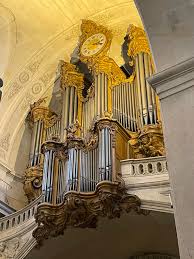
Baroque German Organs and Classic French Organs, Overview
Two important national traditions of organbuilding evolved out of the Renaissance (mid-15th to early-17th century).
1) One was the Classical French organbuilding, as exemplified by the Paris school of builders (1650-1790): LA. & FH. Clicquot, Isnard, Dom Bédos, Thierry.
2) The other great tradition of organbuilding was the Baroque North German/Dutch tradition, as exemplified by Arp Schnitger (1648–1719). There are other schools of organbuilding, but I'm focusing on these two. (The photo is François-Henri Clicquot, 1768, Eglise Saint Gervais & Saint Protais Paris).
Similarities: Classic French Organs vs Baroque North German
Both the French and German manual keyboards are based upon the 8' pitch. That is to say, that if you play middle "c" on either a French or German manual keyboard, you will hear the same pitch, as you would hear on middle "c" of a modern piano.
The German and French chorus evolved from the Renaissance principal chorus of 8', 4', 2', and Hintersatz. Both the German and French divided the ancient Hintersatz into two mixtures: a lower (Gr-Mixture, Fr-Fourniture) and higher (Gr-Scharff or Cymbal, Fr-Cymbale) pitched Mixture. The composition (breaks) of the mixtures were quite similar, but the two traditions used and voiced them quite differently.
The German and French organs where complete as two manual and pedal organs. The third and fourth manuals on large organs were ancillary. They both had pedalboards, though the German pedal division was much larger and was complete as a stand-alone division. Typically both German and French were on the back gallery and included a ruckpositiv on the gallery rail.
The organs both had an 8' Principal on the main division, that moved the center of gravity of tone towards 8'. The Hauptwerk had a 2-2/3' Quint, which helped throw down an 8' resultant, but the Positiv generally didn't (Nazards don't count, they're part of a Cornet-decompose).
An 8' open rank won't fit in a Ruckpositiv, so the RP chorus was based on a 8' Bourdon. The lighter toned RP Bourdon 8' shifted the center of tonal gravity towards 4' (giving it a lighter, brighter tone). The Ruckpositiv's smaller casework's natural resonances also emphasized a brighter tone.
French Differences
The French Grand Orgue had essentially one plenum, the Plein Jeu (full principal chorus, including both Fourniture and Cymbale, but without the 16' foundation, nor reeds). The French Positiv was a miniature Grand Orgue with it's own Plein Jeu w/including both Fourniture and Cymbale. The French Positiv was used as the concertino of the French organ.
German Differences
In contrast, the Classical North German Rückpositiv was the equal, but different, partner of the Hauptwerk. The Hauptwork had a powerful 8' Principal, giving a definite 8' pitch basis; whereas the Positiv had a contrasting, brighter chorus. To emphasize the difference between the two manuals, the Hauptwork used the lower pitched Mixture, but the Ruckpositiv used the brighter Scharf.
Even in big German organs with many stops, the two divisions kept their personalities. Central German, like Gottfried Silbermann and southern German builders were simular, but more romantic as you went south.
Classic French voicing and scaling
The French developed a new scaling method: Additive, where plotted pipes follow a curve. This resulted in principals with chubby basses, skinny midrange, and fat, fluty trebles. The Montres were quite gentle, blending into the Plein Jeu. Though wind pressures relatively high, thanks to smaller pipe toe windholes, the chorus sound was not overwhelming, screamy, brilliant, shrill or high pitched; it was very homogeneous. This is the result of wide treble scales, closed toes, and gentle voicing.
Because the Plein Jeu always included both mixtures, the large numbers of ranks filled the spectrum from 16' to 1/8' with no gaps (just like a Blockwerk!). This providing the brilliance needed to fill large stone buildings. But his “filling of the spectrum” precluded the formation of vowel sounds. The French contrast their clean, vocal-less chorus, with their Cornet and its very strong “Ah” vowel sound.
Unfortunately these "the large numbers of ranks filled the spectrum" meant that when playing, the left-hand sounded a lot like the right-hand, obscuring polyphonic music.
Baroque German Voicing and Scaling
In contrast to the French, the German Principal 8' was powerful, giving a definite 8' pitch basis, and providing a clear pitch reference for listening to polyphonic music. Powerful German mixtures help create a vowel format, by using fewer mixture ranks, strongly voiced and centered around a narrow frequency range (i.e. upper vowel format).
North German (Schnitger) scales, though somewhat crude and inconsistant, are not dissimilar to contemporary work. Indeed, in the mid 20th century, it was fashionable to study and copy Schnitger scaling. On the other hand, Godfried Silbermann's scaling was remarkably consistant.
In Summary
French organs had gentle choruses and bold reeds. German organs had bold choruses and blending reeds. The French never used tierces in mixtures, the Germans rarely used tierces.
Conclusion: Why the Difference?
I think a lot of the difference comes down to Catholic France vs Protestant North Germany. In the beginning both Catholics and Protestants only used the organ for the Prelude and Postlude, before and after the service. Gradually, the Catholic organ was used to accompany trained clergy and choirs followed the Practice of Alternatim. In this tradition, the organ and the choir didn't perform simultaneously as a combined ensemble. Instead, they would alternate verses of the chant. For example, a verse of the Kyrie or Gloria would be sung in plainchant by the choir, and the organ would play the next verse as a solo, often as a richly ornamented composition based on the same chant melody. Also, the French organs of the 1700's and 1800's tended towards being homophonic. The French organ performed well with these tasks.
The Baroque German music was polyphonic (JS Bach). The powerful German Principal 8', gives a definite 8' pitch basis, and giving a clear pitch reference for listening to polyphonic music. Also, the strong Principal 8' plus the powerful Mixtures acted as vowel formats, creating vocal colour. These vowel tones enhance polyphonic clarity and the differentiation of keyboards.
The Protestant church placed a high importance upon congregational singing. The German powerful Principal 8', gives a definite 8' pitch basis, and giving a clear pitch reference for massed singing.
Of course, organbuilding was influenced by the contemporary homophonic sonata forms of the orchestra. While retaining their German or French character, both organbuilding schools gradually declined towards having imitative 8' variety, and gradually abandoning upperwork like mixtures and mutations.
Synopsis
- CLASSICAL FRENCH organ was a disaggregated blockwerk, plus flashy Trumpets and open flutes/cornet added.
- BAROQUE NORTH GERMAN organ was bold, to lead massed singing, and used Mixtures to colour their choruses, clarifying polyphony.
A Note on Temperaments
Tuning temperament is the slight adjustments made to the pitches of notes of the musical scale, so that keyboard instruments (like organs), can play in multiple keys without sounding painfully out of tune. Instruments that play only note at a time and singers, can micro-tune as they play/sing. A cappella choirs and instrumental groups play/sing in just intonation (pure intervals). (Don't tell me that you think a soprano singing an "E", will try to equal-temper it to the Alto's "C"; obviously an accompanied choir will follow the tuning of the supporting instrument.)
The problem with keyboard instruments is, if you tune every interval perfectly (pure, with no beats), the math doesn't add up, and the last interval in the circle of fifths ends up sounding like a "wolf" (a terribly harsh, out-of-tune howl). The Renaissance solution was the meantone temperament, which was easy to tune and left most intervals pure, at the expense of a few wildly unuseable "wolf" notes. By restricting yourself to good keys, the simple harmony of the Renaissance sounded acceptable on meantone. Indeed, Renaissance music exploited the dissonant wolves vs the pure interval resolutions, to add drama to the music.
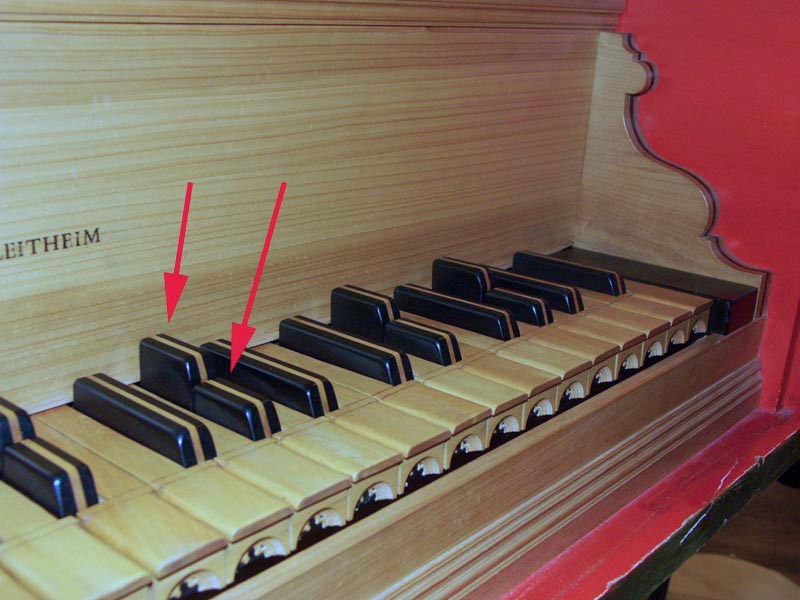
But meantone tuning was so off-kilter, that d# and e(flat) where different notes. Likewise, g# and a(flat) where also different notes. On a clavichord, a solution was for the player to quickly retune all the d# and g# when he wanted to change keys. A more elegant solution was for the instrument builder to provide split keys, one for sharps and the other for flats (see photo).
The Classic French organbuilders and composers loved meantone. It suited their use of modes and they composed music to take advantage of meantone's character. The French love of Tierces and Cornets played well with the pure thirds in meantone temperament. Though eventually, even the most tenacious meantone lovers adapted "modified meantone", dividing the wolves over several intervals.
However, meantone was no longer acceptable to the Baroque Germans. The complex harmony and transposition of the German polyphonic music demanded access to all the notes of the scale. Also, the rise of concertos and keyboard basso continuo demanded a temperment compatable with the orchestra.
Equal temperament where the out-of-tuneness is spread equally between all 12 notes, was known at the time. It was mostly rejected because of its bad thirds, and because it was hard to tune. Initially, they used modified meantone, tweeking wolves to improve it. But finally, the Baroque keyboardists preferred well/just temperaments where the out-of-tuneness was spread unequally.
Indeed it became fashionable among theorists (e.g. Andreas Werckmeister (1645–1706), Johann Philipp Kirnberger (1721–1783), Francesco Antonio Vallotti (1697–1780)) to invent their own unequal temperaments.
JS Bach championed his own unequal temperament, and in 1722 wrote "The Well-Tempered Clavier" (Not the "Equal-tempered Clavier"), to promote the use of well-tempered systems where all 24 major and minor keys were usable.
Pipe organs were very slow at abandoning meantone, because it is extremely difficult and expensive to re-temper a cone tuned instrument. Gottfried Silbermann (1683–1753) was known to stubbornly cling to meantone in his new organs. When Bach was hired to test a new Silbermann organ, Bach was delighted to tease Silberman by deliberately playing music in meantone wolf key.
By the Romantic period, unequal temperaments were largely abandoned for equal temperament. Except for the ever backwards England, where modified meantone temperament was still being used by English organ builders, including Willis, as late as the 1850s.
Personally, in new organs, I much prefer a mild unequal temperament like Kellner (Kellner/Herbert). It is a reconstruction of a Bach-era tuning created by Herbert Anton Kellner, aiming for pure home keys like C major while maintaining distinct tonal colors across the entire circle of fifths.
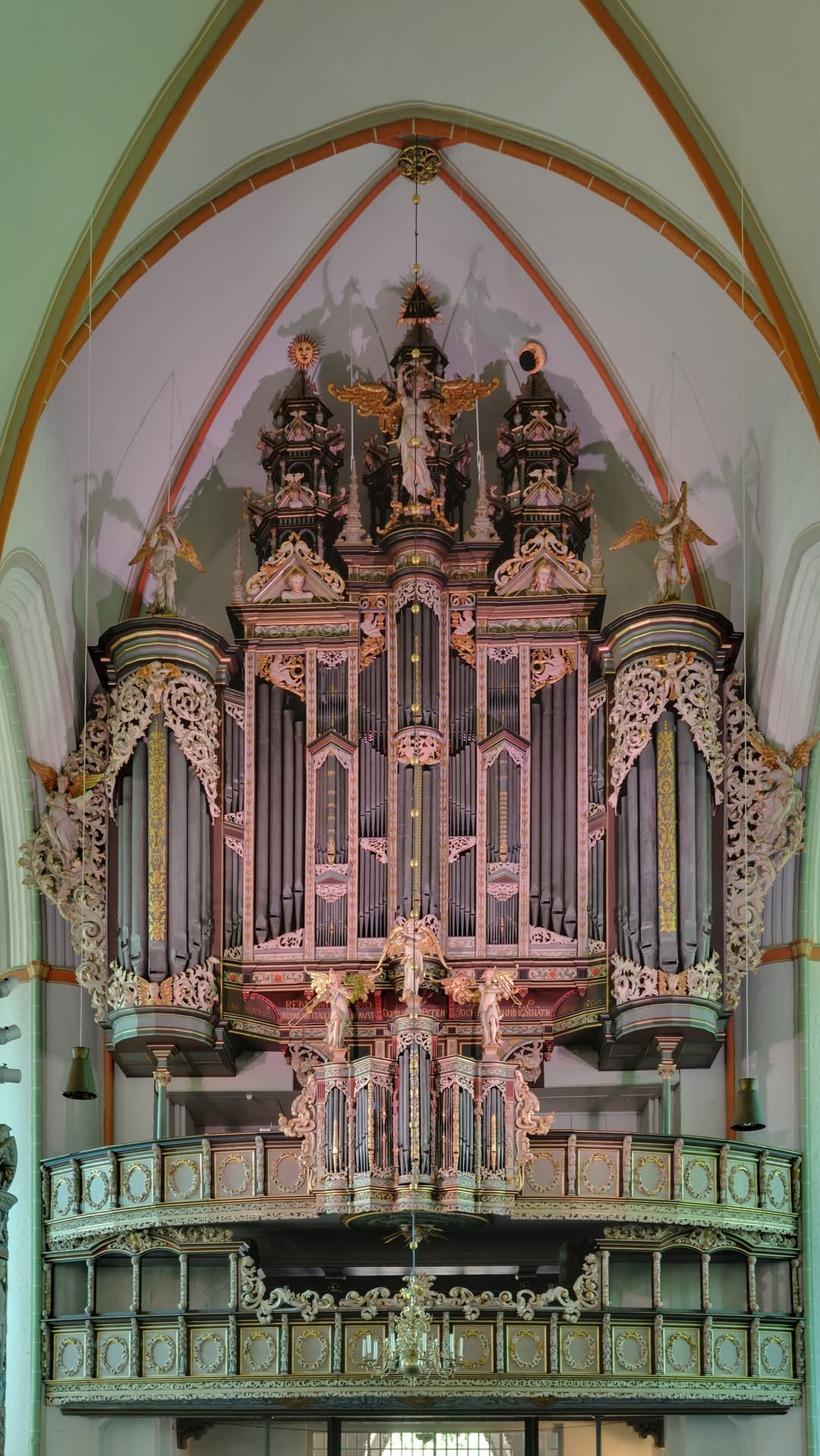
North German Baroque, Hendrik Niehoff-1553, Matthias Dropa-1715
The Niehoff-Dropa organ is located in the St. Johanniskirche (St. John's Church) in Lüneburg, Germany. This started as a large Renaissance organ built by the renowned Dutch organ builder Hendrik Niehoff and Jasper Johansen (1551–1553).
A major Rebuild (1712–1715) brought the organ into the North German Baroque style. Matthias Dropa, a student of the famous Arp Schnitger significantly expanded and modified the organ. Dropa added the pedal towers and more pipework and pipes were shortened from Chorton pitch.
In the 20th century, it was restored by Rudolf von Beckerath (1953, 1976, 1992) to bring it closer to its 1714 state, while retaining much of the historic pipework.
The organ is historically significant because Johann Sebastian Bach likely played it. During his time as a student in Lüneburg (1700–1702), he took lessons from the church's organist, Georg Böhm, on this very instrument. The instrument is one of the most important examples of Niehoff's work. It is a mix of historic pipes from the Niehoff, Dropa, and Meyer eras, alongside some newer additions from the 20th-century restoration.
Current Stoplist as at 1715
Rückpositiv I
- Prinzipal 8′
- Gedackt 8′
- Quintadena 8′
- Oktave 4′
- Rohrflöte 4′
- Sesquialtera 2f
- Waldflöte 2′
- Sifflöte 1 1/3′
- Scharff 5-7f, 1′
- Dulzian 16′
- Bärpfeife 8′
Hauptwerk II
- Prinzipal 16′
- Quintadena 16′
- Oktave 8′
- Gedackt 8′
- Oktave 4′
- Nachthorn 4′
- Quinte 2 2/3′
- Oktave 2′
- Bauernflöte 2′
- Mixtur 6-8f, 1 1/3′
- Scharff 4-5f, 2/3′
- Trompete 16′
- Trompete 8′
- Trompete 4′
Oberwerk III
- Prinzipal 8′
- Rohrflöte 8′
- Oktave 4′
- Blockflöte 4′
- Nasat 2 2/3′
- Gemshorn 2′
- Terzian 2f
- Oktave 1′
- Mixtur 5-6f, 1′
- Zimbel 3f, 1/6′
- Trompete 8′
- Dulzian 8′
Pedal
- Prinzipal 16′
- Untersatz 16′
- Oktave 8′
- Gedackt 8′
- Oktave 4′
- Nachthorn 2′
- Bauernflöte 1′
- Rauschpfeife 2f
- Mixtur 6-8f, 2′
- Posaune 32′
- Posaune 16′
- Trompete 8′
- Trompete 4′
- Kornett 2′
- Prinzipal 8′
- Rohrflöte 8′
- Oktave 4′
- Blockflöte 4′
- Nasat 2 2/3′
- Gemshorn 2′
- Terzian 2f
- Oktave 1′
- Mixtur 5-6f, 1′
- Zimbel 3f, 1/6′
- Trompete 8′
- Dulzian 8′
Pedal
Technical Details:
- Manuals: 3
- Stops: 51
- Manual Range: C – g'''
- Pedal Range: C – f'
- Wind Pressure: 78 mm/WS
- Pitch: 440 Hz (pipes shortened in 1715 from Chorton pitch).
- Temperament: Equal
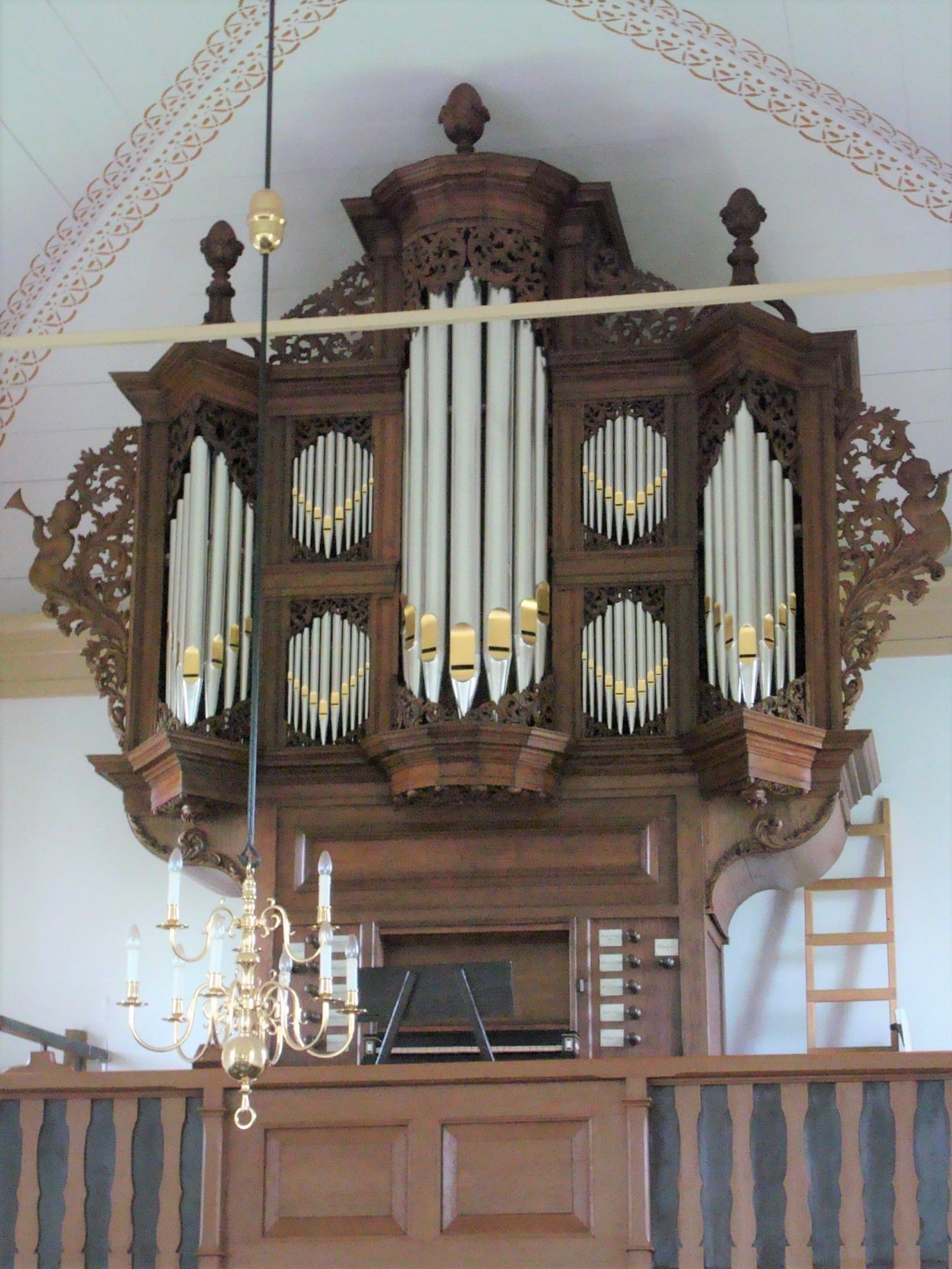
North German Baroque, Arp Schnitger
By the end of the 17th century, North German/Dutch organs developed a consistant style of playing, sound, stoplist, casework (the Hamburg case), best exemplified by Arp Schnitger (1648–1719). Schnitger built in a conservative, traditional, almost backwards looking style of organ, that consolidated and summed up Baroque organbuilding. He is important because so many of his organs survive.
Arp Schnitger (1648-1719) was the idol of the Orgelbewegung. His scaling was very inconsistent between organs, and even within the same organ. This was partly because he enthusiastically recycled pipework from previous instruments. This recycled pipework was very compatible with Schnitger's style of building. Also, Schnitger had the monopoly on organbuilding in the region, so other organbuilders had to work under him as subcontractors who brought their own methods. And, I suspect pipe scaling wasn't particularly important to him, he could work with what he got. He doesn't seem to be following any mathematical, geometrical, proportional, logrithmetic or additive scaling system.
However, people who enjoy analyzing pipe scales, find Schnitger's organs very frustrating. Certainly the general concepts are correct: a Quintatena is a narrow stopped pipe with low cutups; a Gedackt is a fat stopped pipe with high cutups. But Schnitger Gedackts, for example, can look very different from organ to organ, and even within an organ, for no apparent reason, while still being a Gedackt. When studing his instruments, it is better to step back and look at the big picture, and not get stuck on the details.
The Neo-baroque organbuilders were inspired by what they read of Schnitger. However, when you play a typical chiffy neobaroque organ, with low cutups and narrow flues, one wonders how many of them had actually seen or played a Schnitger? The Neo-baroquists built some wonderful organs, but few would be confused with one of Arp's.
Arp Schnitger was the son of a relative of Berendt Huss. He began his apprenticeship with Huss around 1666 and worked on the Stade organ as both apprentice and journeyman. The organ at St. Cosmae in Stade was begun by Berendt Huss and completed by his journeyman, Arp Schnitger, after Huss's death. After Berendt Huss died in 1676, Schnitger also completed Huss's last project at the St. Wilhadi church in Stade, solidifying his own legendary career.
Hendrick Huis and Johannes Huis, organ builders who moved from Oldenburg to Groningen, were brothers of Berendt Huss. Berendt Huss's name also appears in historical records as Berendt Hus or Berendt Huß.
Photo is the Arp Schnitger 1698 organ (typical Hamburg case) in Reformed Church Pieterburen (Groningen).
Other Schnitger Files
- List from 1970's of Historic North European Organs
- Structure of the North German Organ - Harold Vogel
- 1681 - Ludingworth, rebuilt 1597 by Wilde
- 1682 - Steinkirchen, Gt scale graphs
- 1682 - Steinkirchen, Reeds
- 1682 - Steinkirchen, - data from Orgues Historiques
- 1682 - Steinkirchen, scales
- 1688 - Mittelnkirchen, with some older pipes
- 1688 - Mittelnkirchen Scale Graphs
- 1691 - Grasberg bei Bremen
- 1692 - Hollern
- 1692 - Norden, St. Ludgeri Church
- 1693 - Hamburg, St Jacobi
- 1696 - Neuenfelde Stoplist, Arp Schnitger
- 1696 - Neuenfelde Scales, Arp Schnitger
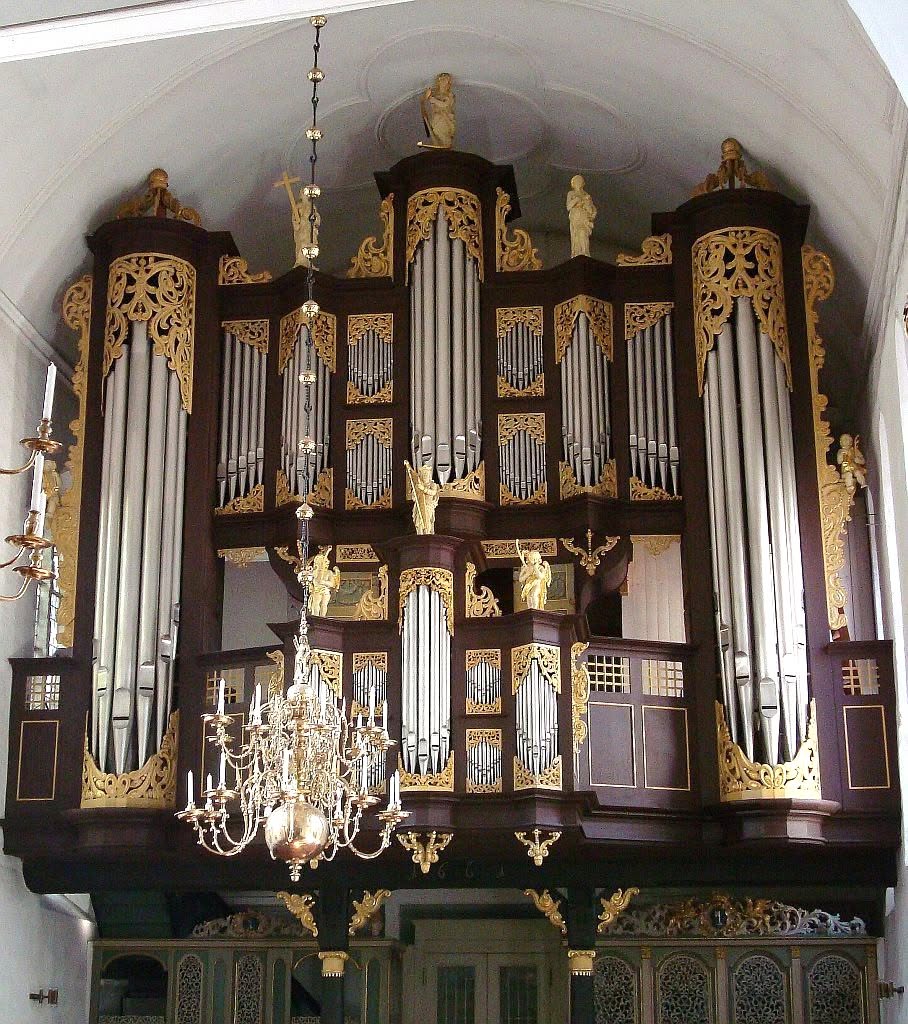
1675 - Arp Schnitger, Stade, Germany, St Cosmae Church
The organ at St. Cosmae in Stade, built by Berendt Huss (Huess) with his apprentice Arp Schnitger and completed in 1675, is one of the most significant surviving Baroque organs in North Germany. Its stoplist, restored to the state after Schnitger's 1688 modifications, comprises 42 stops across three manuals and pedal
This organ is notable for its large proportion of original pipework, particularly its reed stops, which makes it a precious historical sound document. The instrument’s first organist was the renowned composer Vincent Lübeck, who served from 1675 to 1702. The organ was meticulously restored by Jürgen Ahrend in 1975, returning it to the 1688 specification.
Photos 2011 by Tjalling Roosjen.
Oberwerk (Hauptwerk) as at 1975
- Principal 16'
- Quintadena 16'
- Oktave 8
- Gedackt 8'
- Oktave 4'
- Rohrflöte 4'
- Nasat 2 2/3'
- Oktav 2'
- Mixtur VI
- Cimbel III
- Trompete 8'
Rückpositiv
- Principal 8'
- Quintadena 8'
- Rohrflöt 8'
- Oktave 4'
- Waltflöt 2'
- Sieflöt 1 1/3'
- Sieflöt 1 1/3'
- Sesquialter II
- Scharff V
- Dulcian 16'
- Dulcian 16'
- Trechter Regal 8'
Brustwerk
- Gedackt 8'
- Querflöt 8'
- Flöt 4'
- Oktave 2'
- Tertia 1 3/5'
- Nasat Quinte 1 1/3'
- Sedetz 1'
- Scharff III
- Krumphorn 8'
- Schalmey 4'
Pedal
- Principal 16'
- Sub-Bass 16'
- Oktave 8'
- Oktave 8'
- Oktave 4'
- Nachthorn 1'
- Mixtur V-VI
- Posaune 16'
- Posaune 16'
- Dulcian 16'
- Trompete 8'
- Cornet 2'
Other
- Manual Coupler: Brustwerk to Oberwerk
- Tremulant
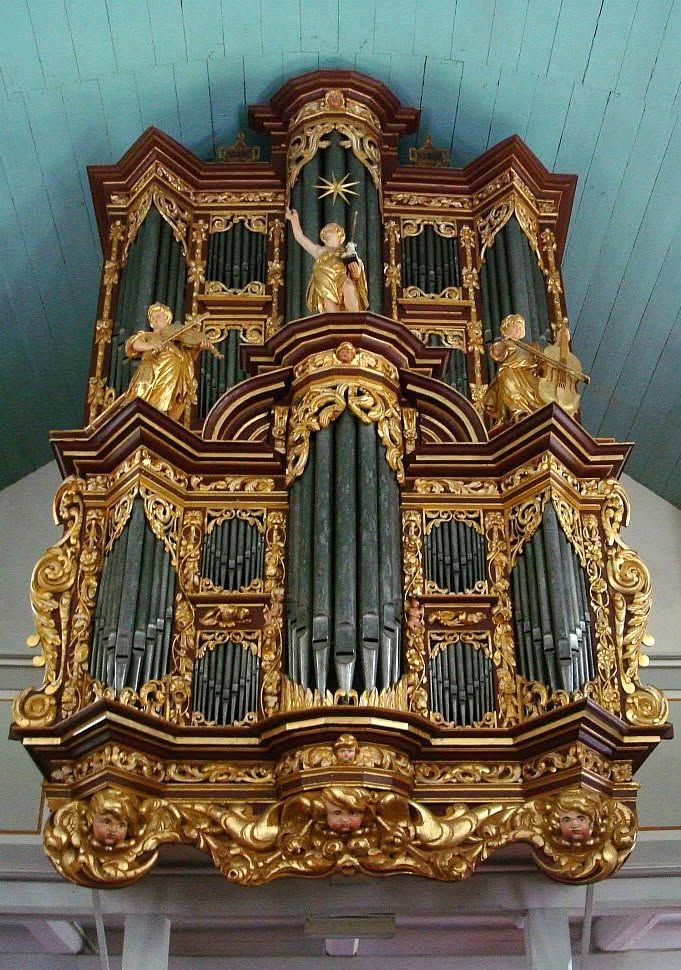
1680 - Arp Schnitger, Cappel, St. Peter and Paul Church
The Arp Schnitger organ in Cappel's St. Peter and Paul Church is a globally significant instrument, widely considered the best-preserved and most sonically authentic large two-manual organ from 17th-century northern Germany.
Built in 1680 for the St. Johannis monastery church in Hamburg, the organ's journey to Cappel in 1816 is a story of fortunate circumstances that led to its remarkable preservation. After the Cappel church burned down in 1810, the congregation, financially drained from rebuilding, purchased this second-hand Schnitger organ instead of commissioning a new one.
The organ's remote location and the congregation's modest means meant it was spared the "improvements" and heavy-handed restorations that altered many other historic instruments in the 19th and early 20th centuries. Its valuable tin (more likely tin-leafed lead) façade pipes survived, as they were overlooked for confiscation (to make bullets) during World War I.
It has 2 manuals and a pedal with 30 stops. About a third of the pipework comes from an earlier, unidentified Renaissance organ (circa 1567), which Schnitger masterfully integrated into his new design. The instrument is tuned in equal temperament, a change made when it was moved to Cappel in 1816. It is tuned to a higher pitch (Chorton), about a half-step above modern concert pitch. It is the most ornately decorated of all Schnitger's surviving organs, featuring intricate woodcarvings by Hamburg sculptor Christian Precht.
The organ's fame was cemented by legendary organist Helmut Walcha, who used it for his landmark recordings of Bach's organ works in 1950 and 1952. Here is a summary of its current disposition, with the origins of the stops marked (S)chnitger, (R)enaissance:
I Rückpositiv
- Principal 4′ (S)
- Gedact 8′ (R)
- Quintadena 8′ (S)
- Floit 4′ (S)
- Octava 2′ (S)
- Siffloit 1 1/2′ (S)
- Sesquialtera II (S)
- Tertian II (S)
- Scharff IV–IV (S)
- Dulcian 16′ (S)
- Trompet 8′ (R)
II Hauptwerk
- Principal 8′ (S)
- Quintadena 16′ (R)
- Hollfloit 8′ (R)
- Octava 4′ (R)
- Spitzfloit 4′ (S)
- Nasat 3′ (R)
- Gemshorn 2′ (R)
- Rauschpfeife II (S)
- Mixtur V–VI (S)
- Cimbel III (B/S)
Pedal as at 2026
- Untersatz 16′ (R)
- Octava 8′ (R)
- Octava 4′ (S)
- Nachthorn 2′ (S)
- Rauschpfeife II (S)
- Mixtur IV–VI (S)
- Posaun 16′ (S)
- Trompet 8′ (S)
- Cornet 2′ (B/S)
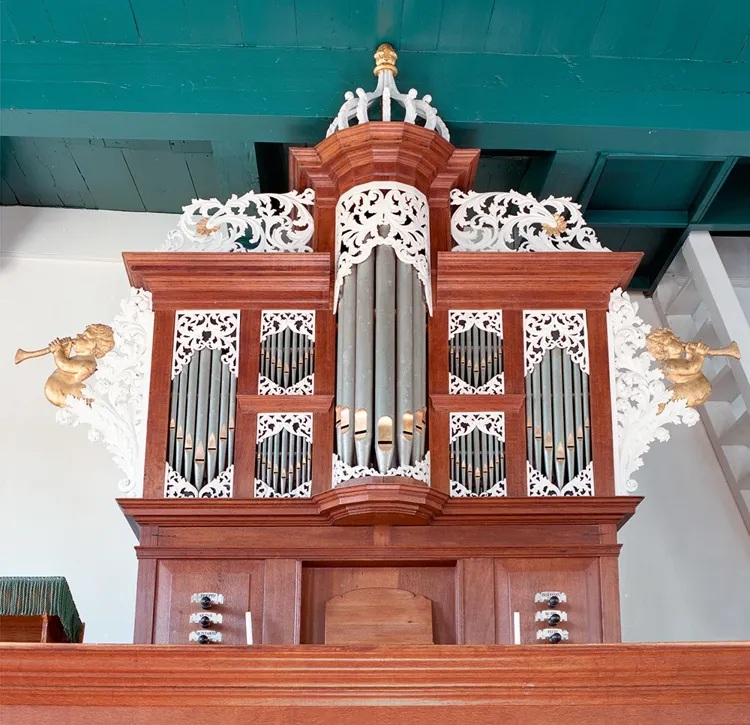
1680 - Arp Schnitger, Nieuw Scheemda
The Schnitger organ in the Dorpskerk of Nieuw-Scheemda is one of the few surviving "positive" organs built by Arp Schnitger. He was awarded the contract to build the organ for the village church in 1695. It was completed in 1698. The organ remains highly original, with substantial parts - including many pipes, the windchest, the keydesk, and the organ case—dating from Schnitger's time. It is one of only two surviving Schnitger positive organs.
This small organ was the loudest screamer I'd ever heard (1977); though that may be attributed to Metzler. The organ underwent significant changes in 1810 by Nicolaas Anthonie Lohman. These alterations were reversed during a major reconstruction in 1968 by the firm Metzler, working with the expert Bernhardt Edskes, which returned the instrument to its original Baroque configuration. Further refinements to the wind pressure and intonation were carried out in 1988.
I Stoplist
- Holpijp 8'
- Quintadena 8' (discant)
- Praestant 4'
- Fluit 4'
- Quint 3'
- Octaaf 2'
- Mixtuur III
- Trompet 8'
- Pedal: Attached ("pull-down")
The temperament is Modified meantone (1/5 comma) and the pitch is Chorton, roughly a half step higher than modern pitch (a1 ≈ 466 Hz).
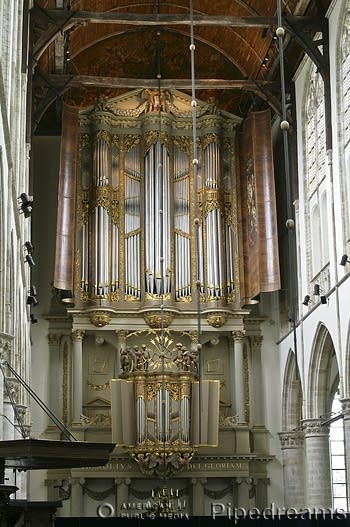
1645/1723 - Frans Caspar Schnitger, Alkmaar, St Laurenskerk
The Big Organ in St Laurenskerk was build by Jacobus Caltus Van Hagerbeer in 1645 and rebuilt by Frans Caspar Schnitger. Frans Caspar Schnitger was a son of Arp Schnitger, the most famous organ builder of his era in Northern Europe. After his father's death in 1719, Frans Caspar and his brother moved the family workshop to the Netherlands, settling in Zwolle. The magnificent case, which stretches from the floor to the vaulted ceiling, was designed by the prominent architect Jacob van Campen.
In 1723, the organ was rebuilt by the famous organ builder Frans Caspar Schnitger. He kept the original case but redesigned the instrument's interior in the North German style, reusing much of the old pipework while adding new mixtures and reeds. Remarkably, it retains about 90% of its original 18th-century material, including pipework, action, and soundboards. Pitch: a' = 415 Hz
The Stoplist
Rugpositief (RP)
- Praestant 8'
- Quintadeen 8'
- Octaav 4'
- Fluit 4'
- Nasaat 3'
- Quintfluit 3'
- Superoctaav 2'
- Waldfluit 2'
- Quintanus 1½'
- Sesquialtera II
- Mixtuur V-VI
- Cimbel III
- Trompet 8'
- Fagot 8'
- Vox Humana 8'
- Hautbois 8'
- Vox Humana 8'
- Tremulant
Hoofdwerk (HW)
- Praestant 16'
- Praestant 8'
- Quintadena 8'
- Octaav 4'
- Quint 3'
- Fluit 4'
- Superoctaav 2'
- Quintfluit 3'
- Quintanus 1½'
- Mixtuur V-VI
- Sexquialtera II
- Cimbel III
- Trompet 8'
- Viool de Gamba 8'
- Trompet 4'
Bovenwerk (BW)
- Praestant 8'
- Baarpyp 8'
- Rohrfluit 8'
- Quintadeen 8'
- Octaav 4'
- Fluit Dous 4'
- Spitsfluit 3'
- Superoctaav 2'
- Speelfluit 2'
- Sexquialtera II
- Mixtuur VI
- Scherp IV
- Cimbel III
- Trompet 16'
- Trompet 8'
- Tremulant
Pedaal (P)
- Principal 22' (32', ab G)
- Praestant 16'
- Rohrquint 12'
- Octaav 8'
- Quint 6'
- Octaav 4'
- Nachthoorn 2'
- Ruyschpyp III
- Mixtuur VIII
- Bazuin 16'
- Trompet 8'
- Trompet 4'
- Cornet 2'
Couplers
- RP/HW
- RP/BW
- HW/BW
- Pedal/HW
- Pedal/RP
The organ is a substantial instrument with III manuals, a pedal, and 56 stops (III/P/56). Schnitger retained a meantone temperament in 1725, and it was only later, in 1765, that it was converted to equal temperament.
Frans Caspar Schnitger Files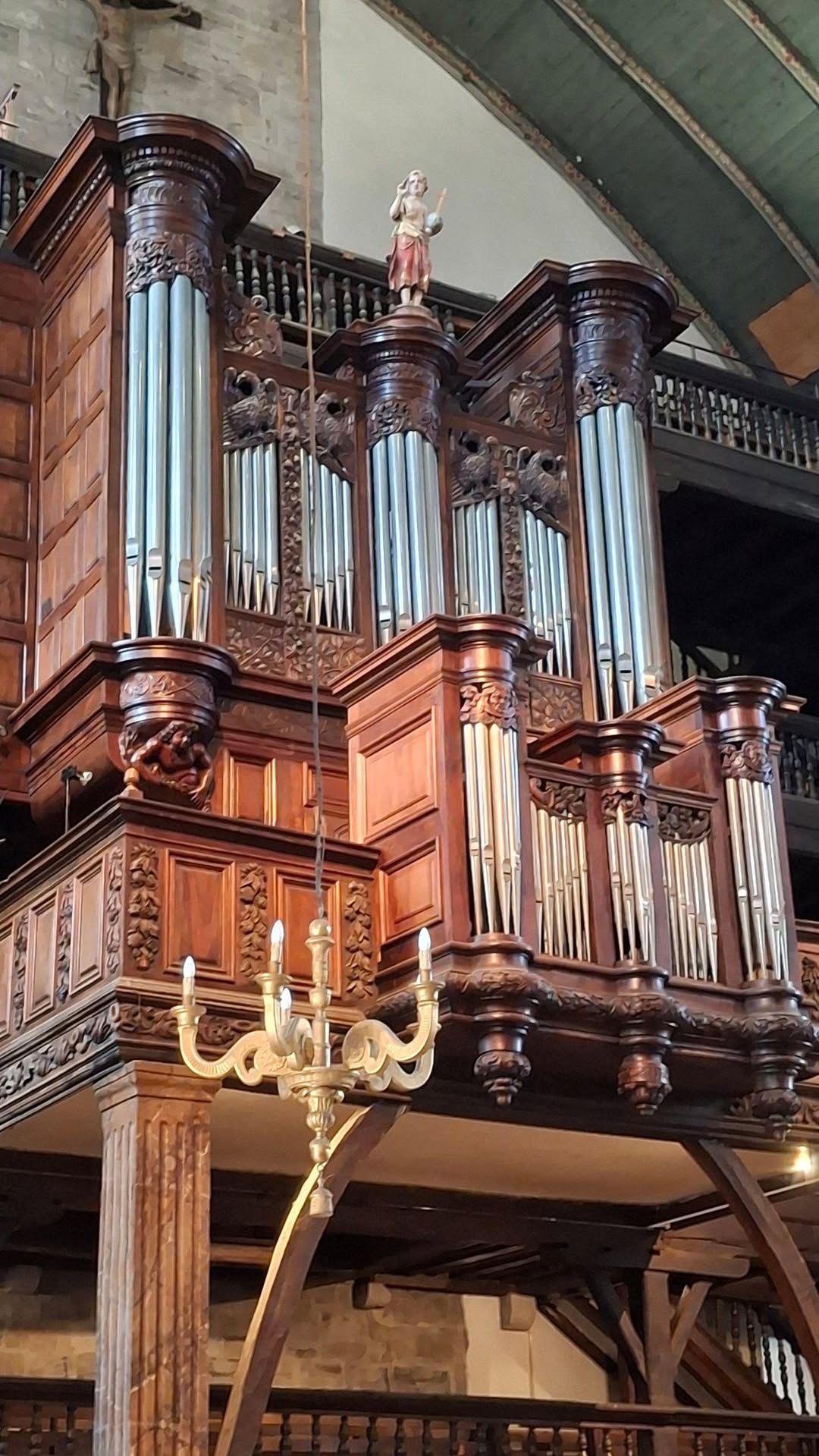
Classic French Organ, 1650-1790, Under Construction
The leading Classic French Organbuilders where the Clicquots, Isnard, Dom Bédos and Thierry. The design of the French organ during Classical was extremely uniform, throughout the entire long period. The Paris Guild of Organbuilders strictly regulated who could be an organbuilder, what the organs could look and sound like, what stops could be used and how they were made.
Simular rules for organists specified the stop combinations, when and how they were chosen, how you played, rules for ordimentation, etc. Performance and organbuilding hardly changed for 200 years. This gradually lead to a stagnation and decline of French organ building and organ music that didn't revive until Cavaillé-Coll (1811-1899).
Pre-1750 Pre-Classical period - early Flemish & French
This is the Renaissance organ previously discussed. As time progressed through the Renaissance, organbuilding in Flemish & French areas gradually developed their own distinct character. This evolution culimated the the French Classical organ.
- 12', 6', and 3' transposing organs.
- 1400s: The earliest organs were probably Brabant style Blockwerks.
- 1500s: Northern France saw the breakup of the blockwerk. Tromps abandoned.
- Narrow Scale Plein Jeu: Principals 16', 8', 4', VIII Fourniture & Cymbal (the remains of the blockwerk, when the 16, 8, & 4 were separated)
- Wide Scale: 8' stopped flute, 4' open flute, 2', 1-1/3', 1' plus 1-3/5' which was introduced with the Cornet from the Netherlands in about the 1580s.
- 1500s: Southern France (Bordeaux) saw Italian style organs: 8', 4', 2', 1-1/3', flutes 8', 2-2/3', 2', regal reeds.
- Similar to English organs of the period.
- French influence in England through Dallam (Brittany) and Harris
Characteristics by 1590
- Consistent use of Trompettes
- Clarion 4' and Cromorne 8' introduced
- Dessus de Cornet V solo and reed treble reinforcer
- Cantus Firmus Pedal Flute 8' and Reed stops
- Compass changed to C
- Positiv developed
- Paris and Rouen became centers of organ development.
1750-1840 Classical period - Clicquot, Isnard, Bédos, Thierry
1789-1799 - French Revolution
1840-1930 Romantic period - Daublin, Callinet, Merklin, Mutin (successor to Cavaillé-Coll)
1858-1898 Symphonic period (subset of Romantic) - Cavaillé-Coll, Théodore Puget and his sons
1930-now Modern period - Victor Gonzales
1840-1930 Romantic period - Daublin, Callinet, Merklin, Mutin (successor to Cavaillé-Coll)
1858-1898 Symphonic period (subset of Romantic) - Cavaillé-Coll, Théodore Puget and his sons
1930-now Modern period - Victor Gonzales
1930-now Modern period - Victor Gonzales
This is the second period of decline. French organbuilding became infected with the German Orgelbewegung (Organ Reform Movement) as a direct reaction to the massive, orchestral-style "symphonic" organs of the 19th century. This led to the destruction or mutilation of many Classical and Symphonic organs and the builders attempted to "correct" and neobaroqueize them. There are several fine contemorary French organbuilders. but I do know much about them, so the modern period won't be explored further here.
A typical French organ is a two manual and pedal organ. The Grand orgue sat in the main case. The console was installed in the lower part of the main case. The second division, The Positiv, was usually perched on the gallery rail, to the organist's back. But the Positiv could also be placed inside the main case, above the Grand Orgue. The pedal was placed behind the main case.
The casework was no longer built with doors. But towers were used to provide more room for the facade pipes, allowing for a narrower, more elegant case. To the left, you can see a typical Baroque French organ, Saint-Jean-de-Luz, Saint-Jean-Baptiste Church (1630-2024).
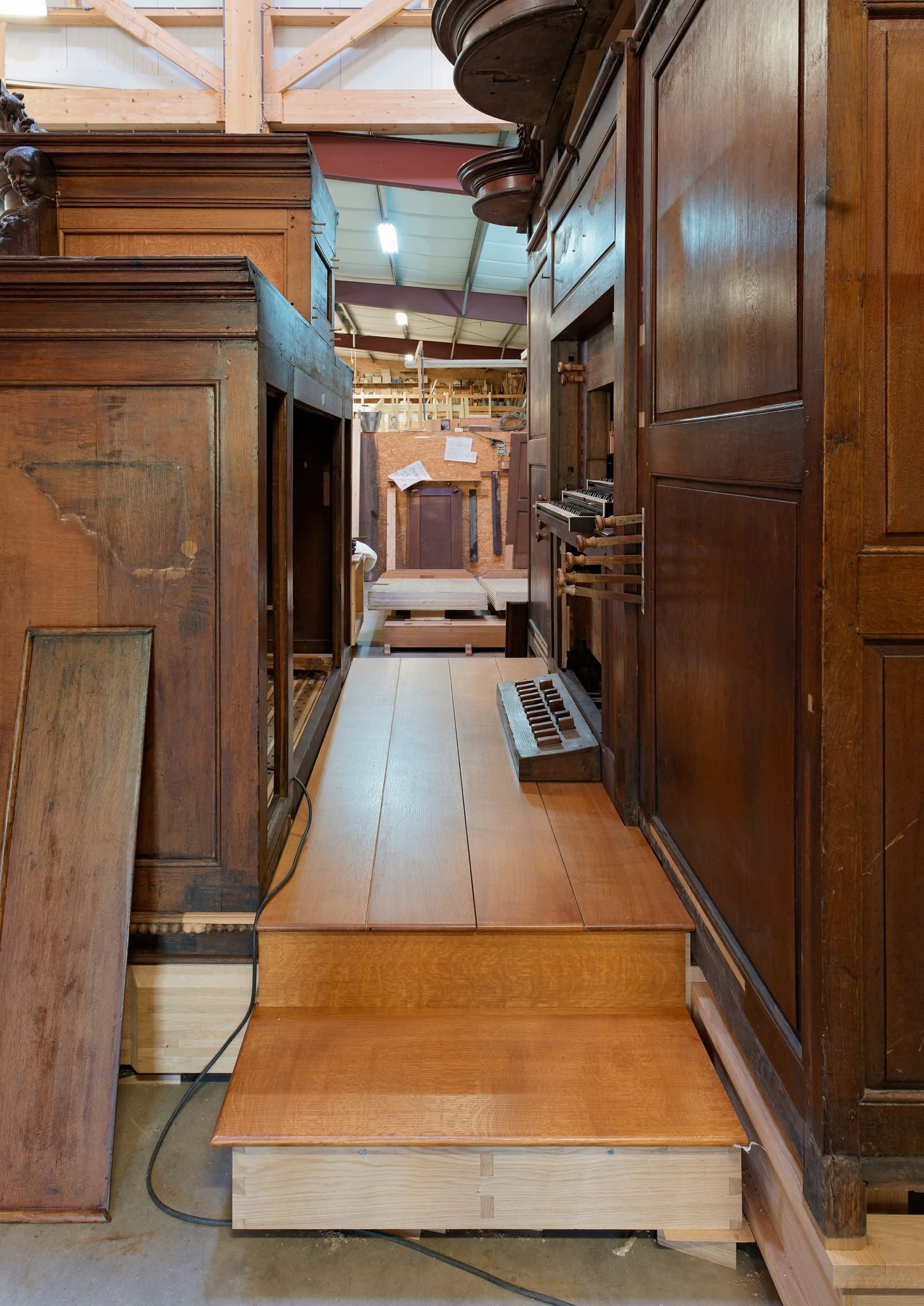
To the right, you can see the organist's console area between the main case and the Positiv. Notice the keyboards, the toe-only short pedalboard, and the drawknobs.
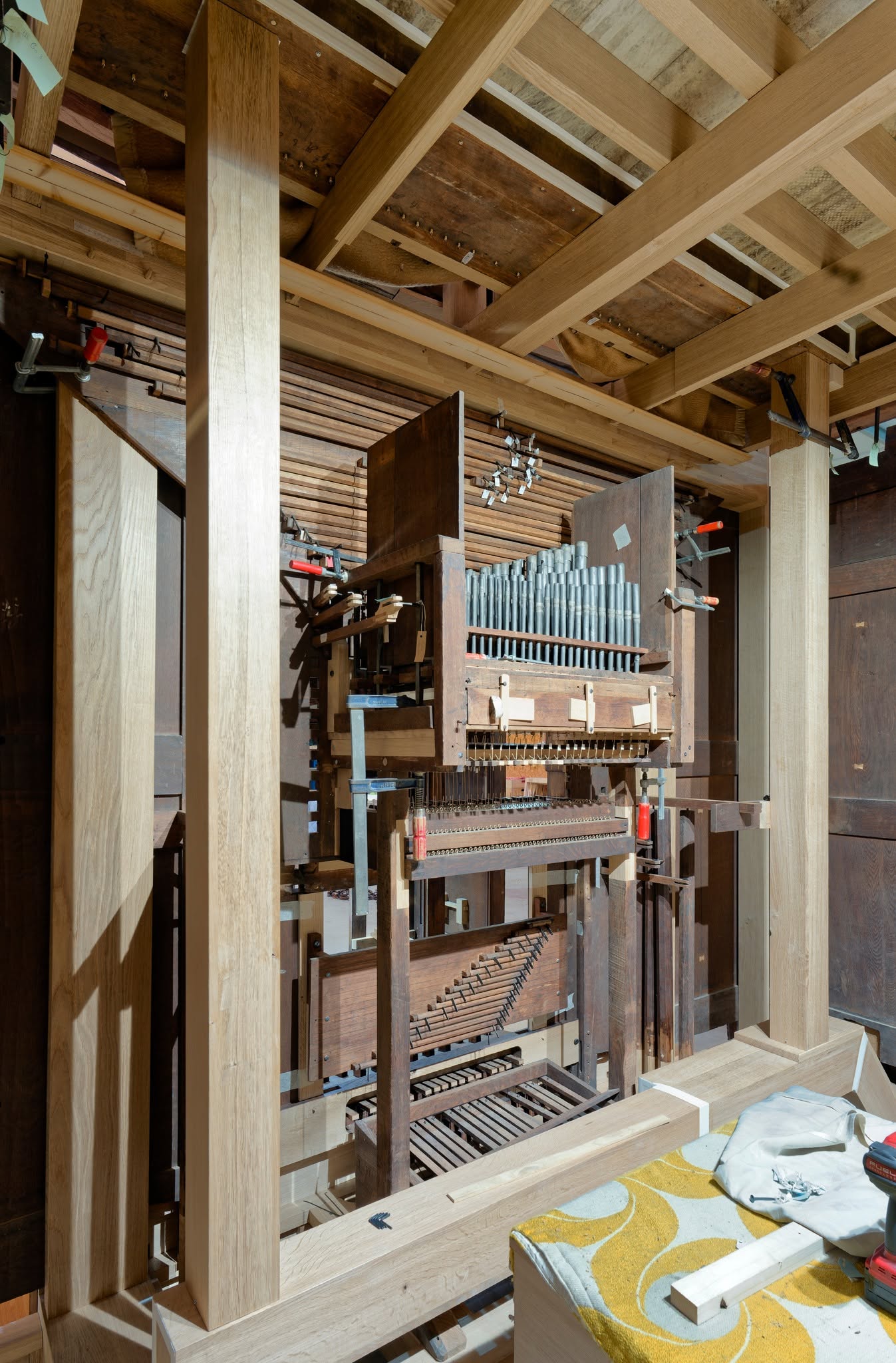
3rd and 4th Keyboards
Any 3rd and 4th keyboards had short compasses for solo sonorities.
The leading Baroque/Classic French Organbuilders where the Clicquots, Isnard, Dom Bédos and Thierry. The design of the French organ during Baroque/Classical was extremely uniform, throughout the entire long period. The Paris Guild of Organbuilders strictly regulated who could be an organbuilder, what the organs could look and sound like, what stops could be used and how they were made. This gradually lead to a stagnation and decline of French organ building and organ music that didn't revive until Cavaillé-Coll (1811-1899). *************** The pedal was intended to play plainchant melodies in long notes ****************
Classical period 1650-1790
- L. A. & F.-H. Clicquot, Isnard, Dom Bédos, Thierry
- Main case not subdivided into a werk-princip style. Case carved.
- Case has a relationship to the internal structure.
- The North German Rückpositiv was the equal partner of the Hauptwerk, whereas the French Positiv was the concertino of the French organ. The French had essentially one plenum, the Grand Plein Jeu. 3rd & 4th keyboards had short compasses for solo sonorities.
The Classical French organ has only five pipe types
- 1. A fluty principal chorus 16', 8', 4', 2', Fourniture, and Cymbale that make up the Plein Jeu.
- 2. Bourdons: stopped flutes 16', 8'.
- 3. Wide cylindrical open flutes; also combined as cornets.
- 4. Powerful Reeds (Trompettes and Bombardes).
- 5. Solo Reeds: Cromorne, Vox Humana, Hautboy.
The Plein jeu
This was the main chorus, similar to the blockwerk, (from which it descended). It is the fluty principal plenum, shown below:
Grand Orgue Positiv 16' Montre 8' Montre 16' Bourdon 8' Bourdon 8' Montre 4' Prestant 8' Bourdon 2' Doublette 4' Prestant Fourniture 2' Doublette Cymbale Fourniture CymbaleMixture Rules • The Fourniture and Cymbale were never used apart. • The Cymbale often broke twice per octave in 4ths and 5ths. • The Fournitures broke once or less per octave in 8ves, usually at f0 and f’. • Mixtures often ran into the 16' and 32' series (5-1/3' and 10-2/3'), and the 2-2/3' entered quite low, often in the bottom or tenor octave. • The number of ranks depends upon the depth of the pitch of the montres. • The Cymbale often had more ranks than the Fourniture. • Fournitures and Cymbales overlapped to a great degree, resulting in doubled ranks. • Tierces are never part of mixtures. • There are typically equal numbers of quints and octaves, or one more octave than the quints. Fourniture Horizontal is the stereotypical classical French mixture where the mixture stays in a strictly delimited acoustical range, by using breaks. Classical Cymbales also keep within a narrow range, using more breaks. Used together, they fill the lower spectrum and fuse with the 8' and 4'. Fourniture Ascendante is a modern style, where the tonal mass climbs upward from the bass to treble. It is better suited for polyphonic music. German mixtures are designed this way, so the vowel format gradually raises towards the treble, also helping to delineate polyphonic music. Progression Harmonique is an extremely ascendant mixture, devised by Cavaillé-Coll. It never really caught on, and even Cavaillé-Coll frequently reverted to classical mixtures. Plein Jeu is a stop name: it is the Fourniture and Cymbale on one draw, though both always keeping separate toeboards. Sometimes the Fourniture is erroneously called a Plein Jeu. Flutes & Cornet Besides supporting the Plein Jeu, the Bourdon 8' was the foundation for all flute combination (plus Bourdon 16' on large organs). The flutes where the components of the Cornet: either full compass separate ranks, treble only ranks, or combined as 5-rank Cornets. The Cornet consists of: 8' Bourdon: can be narrower because it is reinforced by powerful resultants 4' Prestant: very wide and fluty 3' Nazard: lead, large scale 2' Quarte de Nazard: (a fourth above the Nazard), unison mutation to be used with the Nazard and Tierce, lead, large scale. 1-3/5' Tierce: lead, large scale 1-1/3' Larigot: not usually a part of the Cornet, but of the same family. The Cornet was originally from the Netherlands in the mid-1550s. It was frequently progressive, 4 to 6 ranks, including a 1-1/3'. Early references to “Hautboy-Cornet” indicate that it was considered to be imitative of the early Oboe, interchangeably with the organ reed stop. The main use of the Cornet was to reinforce the treble of the Trompettes, to compensate for the way these loud reeds fall off in treble power. By the 1650s a Cornet was given its own treble keyboard as a solo stop. If the chest was below the G. O. it was called Echo, if above the G. O. it was a Recit. • Grand Jeu de Tierce was the full flutes chorus without mixtures. • Early organs had Larigot 1-1/3' and Flageolet 1'; by the mid-17th century the 1' was replaced by Tierces. About 1660 the 3-1/5' (16’ series) was introduced. The 5-1/3' was not introduced until the18th century. The Flute 4' was usually a chimney flute. • The Grand Jeu de Tierce was the full flute chorus with mutations, but without mixtures. • Cornet ranks have a larger scale, with more powerful solo voicing, brilliant and sparkling in tone, than when decomposed as separate ranks. • Cornets are required only in the treble as solo voices. • The Grand Orgue has the largest scaled Cornet, starting from c’, to support the big reeds. • The Positiv has a Cornet if it has Trumpets 8' & 4' (needing support). • The Bombarde division gets a Cornet similar to Grand Orgue, for the same reasons. • The Cornet de Recit has a solo Cornet starting at tenor f (smaller scale than Grand-Orgue). • The Echo has a smaller scaled Cornet than the Recit. • On modern organs Cornet decompose ranks are often Blockflutes (tapered, small mouth width) for a better blend, at the expense of the Cornet flavour (but Blockflutes are never used in Cornets). • Classic Cornets stop at c49 or d51. In modern organs that go higher, you must narrow the scale in the top octave or the pipes will give up speaking. If a pipe’s diameter approaches its body length, it won’t speak. • The Cornet is mounted and voiced with very closed toes to get the characteristic attack/release. • Cornets have wide (1/4) mouths, low (1/4) cutups. Reeds • Grand-Orgue: Trumpet 8', Clairon 4', Vox Humana 8' • Positiv: Cromorne 8', occasionally Trompette 8' • Recit: Oboe 8', occasionally a Trompette 8' • Pedal: Bombarde 16', Trompette 8', Clairon 4' Trompettes were for audacious melodies in the bass or soprano and were the foundation of the Grand Jeu. The Bombarde 16' didn’t appear until the 1690s-1730s. In the 1760s there were sometimes pairs of 8’ Trompettes, for a distinct chorus effect. The Cromorne 8' was used in the ensemble in the Positiv as an echo of the Grand-Orgue Grand Jeu, and in contemplative melodies (bass, tenor, or soprano). The Vox Humana (always used with the Bourdon 8' and the tremulant) was used for tender airs and chords. By the time of Dom Bédos and Clicquot the organs became associated with very loud Trompettes and many flutes. The Vox Humana was placed on the Grand-Orgue because only the Positiv had flutes soft enough to accompany it. Grand Jeu: Chorus reeds and the separate mutations, perhaps the Cornet. No mixtures. Some Notes on the Reeds Resonators • French resonators have high tin content: 70-90%. • Metal thickness is thin at the top, thicker at the block. • Cut dead to length with no slots, just flat of the fly-off point (with a strong fundamental). • Beware of copying (large reverberant French buildings moderate the powerful fire). Shallots • Parallel shallots, opened full length, and later often with domed ends. • Cavaillé-Coll had three scales: large, medium and small. • C-C have 4 face widths: cut to 1/2, 2/3, 3/4 variable shallot heights (but less than 3/4). • C-C tended towards a narrower face as he approached the symphonic period. • Romantic and Symphonic had narrower faces to give a rounder sound with less harmonics. Used a higher wind pressure in the treble to maintain treble power. • Earlier periods have wider scales and faces • Shallots are forged from one piece of brass, including the domed ends. • The 16' Basson and Hautbois bass shallot has a slight taper and a soldered plate with a teardrop opening cut into the plate (allowing the use of wider tongues). Reed Construction • Double nut blocks for all cylindrical ranks, and 4' and up for oboes and trumpets. • Blocks must be filed to fit the boot perfectly, or the tone suffers. Round wedges. • Avoided supports at the top, which may deaden the tone. • Boots of heavy lead. Main Sounds of the Classical Organ • Plein Jeu: full Grand-Orgue (no reeds or open Flutes except for a cantus firmus Pedal). • Grand Jeu de Tierce: full flutes chorus with mutations, but no mixtures. • Grand Jeu: Reeds, mutations, and some foundations, perhaps strengthened by Cornet. • Fond d’Orgue: all flutes and principals at 16', 8', 4', with possibly the Positiv coupled to the Grand-Orgue. • The Bourdon 8' plus the Prestant 4' formed the “foundation” for the Trompettes. Characteristics of the Classical Organ • Principals and reeds have tin bodies, lead feet. Flutes are lead. • All metal pipes were hammered. • Pedal basses and manual stopped basses are of wood. • Organs are described by size of pipe (e.g., 16', 8' organ), a Grand 8' organ had a Bourdon 16', a Petit 8' organ did not. • The G. O. and Positiv each have a Plein Jeu chorus and a Grand Jeu de Tierce chorus. • If the G. O. has Trompettes 8' & 4', it needs a mounted Cornet from middle c to strengthen the treble. • The third keyboard (recit) is a treble keyboard for solos, with a Cornet, Trompette or Hautbois. • By the mid-18th century, the 16' Bombarde division had its own keyboard (plus a few Trompettes). • The Gross Tierce 3-1/5' provides an excellent bass line in duos and trios as a foil to the other part played on a Cornet. • Very big, loud reeds from the 18th century (Clicquot). • Watch the pitch: organs were 1-1/2 to 2 HT flat, strongly affecting the relative scaling. • Pallets, etc., didn’t need to be large, as a full tutti was never played
Sound of the Baroque French Organ
The French had essentially one plenum, the Plein Jeu. The French Positiv was a minature Grand Orgue, used as the concertino of the French organ.
Whereas the Classical North German Rückpositiv was the equal, but different, partner of the Hauptwerk.
The Plein jeu
This was the standard full principal chorus without the 16' foundation, similar to the blockwerk, (from which it descended). It was the fluty principal plenum, shown below. The "Grand plein jeu" was the same principal chorus, plus the 16' foundation stops, for a grander, deeper sound.
The Plein Jeu is basically a disaggregated Gothic blockwerk, except the mixtures break back at plafonds, instead of the Gothic practice of ascending as high as possible. I suspect the main reason for the French mixture breaks was to prevent the mixture from going too high and becoming screamy.
Though many ranks were involved and wind pressures relatively high, the chorus sound was not overwhelming, screamy, brilliant, shrill or high pitched; it was very homogeneous. This is the result of wide treble scales, closed toes, and gentle voicing. The Montres were quite gentle, blending into the Plein Jeu.
Grand Orgue Plein Jeu
- 16' Montre
- 16' Bourdon
- 8' Montre
- 8' Bourdon
- 4' Prestant
- 2' Doublette
- Fourniture
- Cymbale
Positiv Plein Jeu
- 8' Montre
- 8' Bourdon
- 4' Prestant
- 4' Prestant
- 2' Doublette
- Fourniture
- Cymbale
No reeds, narrow or wide tierces, or flutes (other than the 16’ & 8’ Bourdons) were ever included in the Plein Jeu. There is no separate 2-2/3' rank in the Plein Jeu.
The Classical French organ has only five pipe types:
- The Plein Jeu - a fluty principal chorus 16', 8', 4', 2', Fourniture, and Cymbale.
- Bourdons: stopped flutes 16', 8'.
- Wide cylindrical open flutes; also combined as cornets.
- Powerful Reeds (Trompettes and Bombardes).
- Solo Reeds: Cromorne, Vox Humana, Hautboy.
The French organs of the classical period where uniquely French. They were constructed according to strict rules, to conform to specified appearance, construction, stoplist design and sound. The way the organs where played also regulated, with specific instructions as to how the stops were to be registered and even how the ornamentation was to be played. And thanks to Dom Bedoes and Cliquoit's books, we have those design rules.
Strict Design Rules
The strict design rules of the classical French pipe organ were enforced by the powerful guild system (maîtrise et jurande) of instrument makers in Paris, backed by royal authority. In 1599, King Henri IV officially granted the instrument makers' guild its letters of patent. This created a legal monopoly, meaning only guild members could legally build organs in Paris.
The path to becoming a master organbuilder was rigidly controlled. It required a six-year apprenticeship, followed by a fee and the completion of a "masterpiece" (chef-d'œuvre) to prove one's skill. The guild was run by elected or appointed officials called jurés (jurors) and gardes (guards). These individuals had the authority to inspect workshops and products to ensure all members were following the guild's regulations.
This system ensured a consistent, high-quality "French classical" sound across different builders. It wasn't until the French Revolution in 1791 that these guilds were abolished and the profession was opened to free competition. The guild system ensured that French organbuilding was stagnant and unchanging for several centuries. It was the French Revolution that freed Cavaille-Coll to invent a new kind of French organ.
French Organ Characteristics
The Classic French Organ represented a unique high point in organ building and composition. This period produced a remarkably standardized instrument, perfect for a specific and highly refined musical language. The French Classical organ school reached its peak under the reign of Louis XIV, driven by a strong sense of French national identity in the arts. The most distinctive feature of this school is its division of stops into two contrasting sonic categories. Composers would specify which to use:
1) The Plein Jeu (Full Play): A bright, clear, and powerful chorus based on principal pipes (like 8', 4', 2' ranks). It was often used for strict, contrapuntal writing. No reeds!
2) The Grand Jeu (Great Play): A loud, majestic, and reedy combination, typically featuring the Trompette and Clairon stops, often with a Cornet to fill out the treble. This was used for grand, declamatory passages.
Uniquely classical French stops were the brilliantly powerful Trumpettes, colourful reed stops: Voix Humaine, Cromorne, Haut Bois, powerful composite Cornet V, and the strong, fluty mutations: Nazard, Quart 2', Larigot, Tierce (basically a decomposed Cornet).
Composers
This era was defined by a close partnership between famous builders (like the Thierry and Clicquot families) and renowned composer-organists (such as François Couperin and Louis-Nicolas Clérambault). Composers wrote "Masses," "Suites," and "Noëls" (Christmas carol variations) that were organized by the modes of the church. The music is highly ornamented and deeply connected to the rhythm and phrasing of French speech and dance.
Classical French Organs- L'Art du facteur d'orgues - Dom François Bedos de Celles - 1778
- Théorie-pratique de la facture de l'orgue - François-Henri Clicquot (1732–1790) - 1789
- 1689 - Notre-Dame Cath, Rouen, Robert Cliquot
- 1782 - Souvigny, Clicquot
French, Dom Bedos
François-Lamathe Dom Bédos de Celles de Salelles (1709-1779) was a Benedictine monk, organbuilder and author of the treatise L’art du facteur d’orgues, 1766-78. This book gives a wealth of information about every detail of building the French organ of the eighteenth century and is a necessary reference for any serious organbuilder.
The best edition is Charles Ferguson’s translation The Organ- Builder (Raleigh, North Carolina, Sunbury Press, 1977). It is a huge book, because all the plates and drawings were reproduced full size. Bédos showed his pipe measurements as full-size graphs, so reproduction accuracy was important.
He provides useful information about every detail of organbuilding: Casework design, stoplists, pipemaking, bellows and windchest making, pipe scale layout, gluing. As a recognized organbuilder, he was called upon to carry out repairs and appraise and advise other organbuilders across France.
- Dom Bedoes' pipe scales by Blair Batty)
- L'Art du facteur d'orgues - Dom François Bedos de Celles - 1778
 <
<
French Romantic Organbuilding Cavaille-Coll
The photo is the 1864 Aristide Cavaillé-Coll organ in Moissac Abbey (France). The case dates from the mid-17th century.
The Romantic French school of organbuilding is defined by a single, towering figure: Aristide Cavaillé-Coll (1811-1899). He didn't just build instruments; he created a new kind of symphonic organ that revolutionized composition and performance, inspiring a golden age of French organ music that continues to this day .
Think of him as the "Stradivarius of the organ," whose instruments were so inspirational that they essentially created their own repertoire. Before Cavaillé-Coll, French organs were in a state of decline. He changed everything.
His career was launched with a major commission to rebuild the organ at the Abbey of St. Denis in Paris, completed in 1841. This early masterpiece caught the attention of the establishment, and with the support of Napoleon III, he received government contracts to rebuild many of the great cathedral organs in France, providing him with a platform to develop and perfect his revolutionary ideas . Iconic examples of his work can still be heard today in places like Saint-Sulpice and Saint-Ouen in Rouen .
Sound of Cavaillé-Coll
Cavaillé-Coll's instruments evolved from the romantic organ. They were capable of the same power, colour, and nuance as a full Romantic orchestra and could ably play orchestral transcriptions. His organs were not built for the intricate polyphony of the Baroque era, but for sweeping melodies, lush harmonies, and dramatic dynamic swells. This created a sonic palette that could imitate different sections of an orchestra—flutes, strings, and reeds—and, most importantly, blend together seamlessly.
But Cavaillé-Coll's genius was to reimagine the organ as a new kind of symphonic instrument. He invented new stops, like Harmonic Flutes and voiced his pipes to produce a rich, foundational sound built on a wide variety of foundational 8' stops. He also introduced many mechanical devices that transformed the way the instrument could be played.
Cavaillé-Coll's new symphonic organs inspired a new form of music. A remarkable lineage of organist-composers, many of whom held posts at the very churches where Cavaillé-Coll had built organs, wrote music that was inextricably linked to their new "symphonic" sound.
On the internet, someone suggested "The Essential Cavaille-Coll Recit:" which I include here. I would also want a Prestant 4', as a tuning stop.
- The Essential Cavaille-Coll Recit:
- 8’ Flute Traversiere
- 8’ Viole de Gambe
- 8’ Voix Celeste
- 8’ Bourdon
- 4’ Flute Octaviante
- 2’ Octavin
- 8’ Trumpette
- 8’ Basson-Hautbois
- 8’ Voix Humaine
Key Innovations of the Cavaillé-Coll Organ
The Appel (Ventil) System: This was a brilliant innovation. Instead of a single, massive crescendo, Cavaillé-Coll divided the organ's wind supply into different "departments." By using foot pedals (appels), the organist could bring in entire families of stops (like the reeds or the mixtures) at once, creating a series of terraced dynamic plateaus. This allowed for dramatic, orchestral-style build-ups of sound.
Expressive Swell Boxes: While not his invention, he perfected the récit expressif (expressive division). This was a box enclosing a set of pipes with Venetian-style shutters that could be opened and closed by a pedal, allowing for controlled crescendos and diminuendos on a single division—a truly Romantic capability .
The Barker Lever: For his massive instruments with heavy key action, Cavaillé-Coll employed the Barker lever, a pneumatic assist system that made it possible to couple multiple manuals together without the keys becoming impossibly heavy for the organist to press. This made his monumental symphonic organs physically playable.
The Composers
Cavaillé-Coll's instruments didn't just accompany church services; it inspired a new school of music, the organ symphony. This school is often traced through a direct pedagogical lineage, with Cavaillé-Coll as its central, unifying figure. The following table illustrates some of its key members:
- César Franck (1822-1890) The "father" of the school; his chromatic harmony and cyclical forms.
- Camille Saint-Saëns (1835-1921) A close friend and advocate of Cavaillé-Coll, he bridged the worlds of organ and orchestra .
- Charles-Marie Widor (1844-1937) His ten symphonies for organ, defined the genre of the organ symphony.
- Louis Vierne (1870-1937) Widor's successor at Notre-Dame, his six organ symphonies where the heights of complexity and emotion.
- Marcel Dupré (1886-1971) A virtuoso and improviser, codified the teachings of the school, composed monumental works like the Symphonie-Passion.
- Maurice Duruflé (1902-1986) The last great proponent of the French romantic school of organ playing," "eloquent lyricism" and "controlled sensitivity" .
- Olivier Messiaen (1908-1992) His mystical works explore colour and rhythm in ways only possible on the rich palette of the French Romantic organ.
The legacy of the Romantic French school is a testament to the powerful synergy between a visionary builder and the inspired musicians who played his instruments. The organs of Cavaillé-Coll didn't just accompany a musical style; they actively created it.
- Cavaille-Coll Scaling by Blair Batty
- Experiments on Organ Pipe lengths - Cavaille-Coll
- Notebook by Cavaille-Coll, Aristide, 1811-1899

French Alsace, the Silbermanns
Europeans continuously squabble and make war amongst themselves, and they're still doing it. The Alsace region has the misfortune of being a highly desirable bit of land sitting between France and Germany.
After the collapse of Charlemagne’s empire (the Treaty of Verdun, 843), Alsace became part of the German speaking Holy Roman Empire. Then, after the Thirty Years' War 1618 to 1648, the Peace of Westphalia (1648) formally granted most of Alsace to France, though German remained the common language. The French ruled from 1681 to 1871 (Silbermann period) , though the vast majority of people continued speaking Alsatian (a German dialect). The region became one of France's most prosperous and industrialized areas.
After France's defeat in the Franco-Prussian War, The German Empire annexed Alsace in the Treaty of Frankfurt (1871). Alsace returned to France in 1919, after Germany's defeat in World War I. In short, the history of Alsace is a story of shifting borders between two great powers, which created a resilient, hybrid culture that is neither entirely French nor German, but uniquely Alsatian.
French organbuilding, as done in Paris in 1700's, was remarkably standardized, with strict tonal and design rules, and how the organs were to be played. But, if you travel east to the Alsatian towns, far from Paris, organbuilding is much more amenable to Germanic ideas.
Andreas Silbermann, a skilled cabinetmaker from Saxony, moved to Strasbourg, Alsace in 1699 to train as an organbuilder. Then in 1704, Andreas Silbermann moved to Paris to study the French organ-building style with François Thierry. He went, to complete is apprenticeship and earn his master organbuilder accreditation.
In 1701, at the age of 19, Andreas' younger brother Gottfried moved from his home in Saxony to Strasbourg to join Andreas to also apprentice as an organbuilder. Gottfried remained in Strasburg, and in 1706 Andreas returned to rejoin Gottfried in Strasburg where they built organs together. Then, in 1719 Gottfried returned to Freiberg, Saxony to set up his own organbuilding business. Andreas stayed in Strasbourg for the rest of his life, building organs.
So we have two Germans who moved to the fringes of France (Alsace), far from Paris but contagious to Germany, where half the churches are Lutheran and everyone is bilingual. The consequence is that Andreas ended up building French organs with a German accent. But Gottfried built German organs with a strong French accent. They both used simular curved French additive pipe scaling, but not curved as aggressively as in Parisian Bedoes. Their Principal scales didn't grow as fat in the bass or treble, making them useful for chorus. Andreas' voicing was in the refined French style, but Gottfried's chorus voicing was much more aggressive, aided by his use of higher wind pressures, making his pipes more suitable for north German polyphony. Both brothers used french scales for mutations, flutes and Cornets.
Gottfried Silbermann's reed pipes were a mix of French building techniques and German Baroque tradition. He used large scale, closed shallots, and his trumpets integrated into the overall ensemble without being harsh or overpowering. Andreas' French reeds were a splash of exciting power, overwhelming everything.
The result is that Gottfried's organs were a synthasis of German and French ideas, making it an eclectic instrument that was versatile, performing both French and German Repertoire. Also, Gottfried was very consistant in his design and scaling of his organs, making his organs easier to copy. Gottfried's organs are an excellent model for contemporary organs.

Andreas Silbermann
Andreas Silbermann (1678–1734) was a highly influential French organ builder of the late Baroque period, and a central figure in the famous Silbermann family of organ builders. He was the older brother of Gottfried Silbermann (1683–1753), who became even more famous. The brothers learned organ building in Alsace (then part of the Holy Roman Empire, now France) from another important builder, Andreas’s brother-in-law, Johann Friedrich Wender, and were also influenced by French organ building traditions.
Andreas settled in Strasbourg (in present-day France) and built organs mainly in the Alsace region, as well as parts of southwestern Germany. His organs were known for their clear, balanced tone, fine craftsmanship, and incorporation of French classical organ features (reeds, mutations) into German liturgical music needs. He built about 30 organs, many of which survive in restored or partially original condition. Today, Andreas is seen as the founder of the Alsace branch of Silbermann organ building, while Gottfried led the Saxon branch blending German and French aesthetics.
Andreas younger brother, Gottfried Silbermann, was forced to flee to Germany to escape prison after a scandel. In Germany he build German organs with a strong French accent. Gottfried worked in Saxony and became the preferred builder for J.S. Bach’s circle, with a somewhat different tonal style (more German Baroque, influenced by central German traditions).
- Andreas Silbermann (1678-1734)
- Gottfried Silbermann (1683-1753)
- Johann Andreas Silbermann (1712-1783), son of Andreas
Andreas' son Johann Andreas Silbermann (1712–1783) inherited the Strasbourg workshop and documented many Alsace organs in detailed organ surveys. He continued his father's Alsatian style but was also influenced by his uncle Gottfried's Saxony German accent. He worked primarily in Alsace (now France). He was known for his meticulous craftsmanship, elegant cases, and a sound that blends French elegance with German solidity. Johann Andreas adapted German scaling for his principals, while continuing French scales for Flutes and Mutations. However, Gottfried Silberman continued using French scales.
Notable Surviving Andreas Organs
Notable Surviving Johann Andreas Organs (the son)

Central German Baroque Gottfried Silbermann
Gottfried Silbermann was Andreas younger brother, and he learned organbuilding from Andreas. Gottfried was forced to flee from Alsace to Germany to escape prison after a scandel. In Germany he build German organs with a strong French accent. His scaling was very simular to Andreas, but his voicing was much more agressive. Gottfried worked in Saxony and became the preferred builder for J.S. Bach’s circle, with a somewhat different tonal style (more German Baroque, influenced by central German traditions).
Gottfried Silbermann (1683–1753) was building organs that consolidated German and French ideas. He was building an organ looking away from the early Baroque and toward the future, even hinting at Romantic ideas. He never recycled old pipework as it wasn't compatible with his organs, and kept tight personal control over the design of his instruments. The stoplists, casework, voicing and scaling were very consistant from organ to organ.
Because so many Silbermann organs have survived to the present, have a uniformity of design, and are simular to modern American-Classic organs, Gottfried's organs were greatly admired and copied by builders like Larry Phelps. Indeed, add a Gamba and Celeste to a Silberman and you get a stoplist that could easily be confused with a modern organ.
Notice that the central German organ casework is styled differently that the Schnitger North German cases. (Photo is Frankenstein, Dorfkirche, Sachsen, Germany - Gottfried Silbermann 1753.)
- Gottfried Silbermann's Fluework - by Colin Pykett
- Planning your Silbermann Tour
- Gottfried Silbermann: Master Organ-Builder of the German Baroque
- 1728 - Lahm im Itz, Schlosskirck, Herbst, scales (not Silbermann, but in his style.)
- Lots more Silbermann to come...
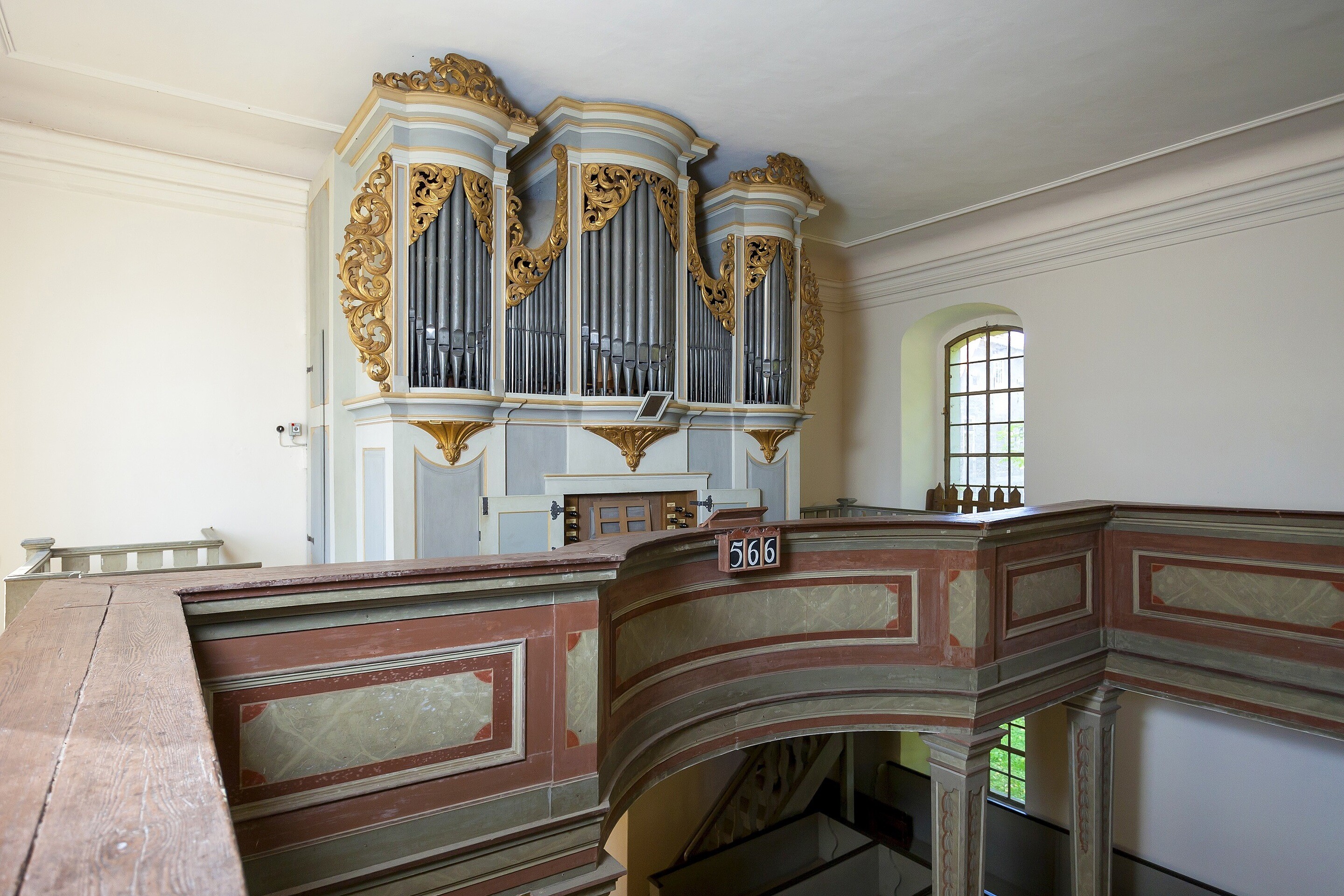
Gottfried Silbermann, Pöppelmann Church in Lebusa
The organ is located in the village church of Lebusa (also known as the Pöppelmann Church), Brandenburg, Germany. This is a small, but typical Gottfried Silbermann instrument, built in 1727. It has 14 stops, distributed across one manual and the pedal.
The reason it stands here is historical: until 1815, Lebusa belonged to the Electorate of Saxony. The local lord of the manor at the time, General Moritz Friedrich von Milkau, commissioned the church. For its design, he brought in the best of his era: the famous architect Matthäus Daniel Pöppelmann (designer of the Dresden Zwinger) and the master organ builder Gottfried Silbermann.
By the 1990s, the organ was severely endangered by moisture and the passage of time. The much-needed comprehensive restoration was finally carried out in 1997 by Jehmlich Orgelbau Dresden.
Hauptwerk, C,D – c³, as at 2026
- Principal 8′
- Quintatön 8′
- Grobgedackt 8′
- Prestant 4′
- Rohrflöte 4′
- Quinta 3′
- Nasat 2′
- Octave 1½′
- Quinta 1′
- Sifflöt 3′
- Cornet III
- Mixtur III
Pedal (C – c¹)
- Posaunenbass 16′
- Subbass 8
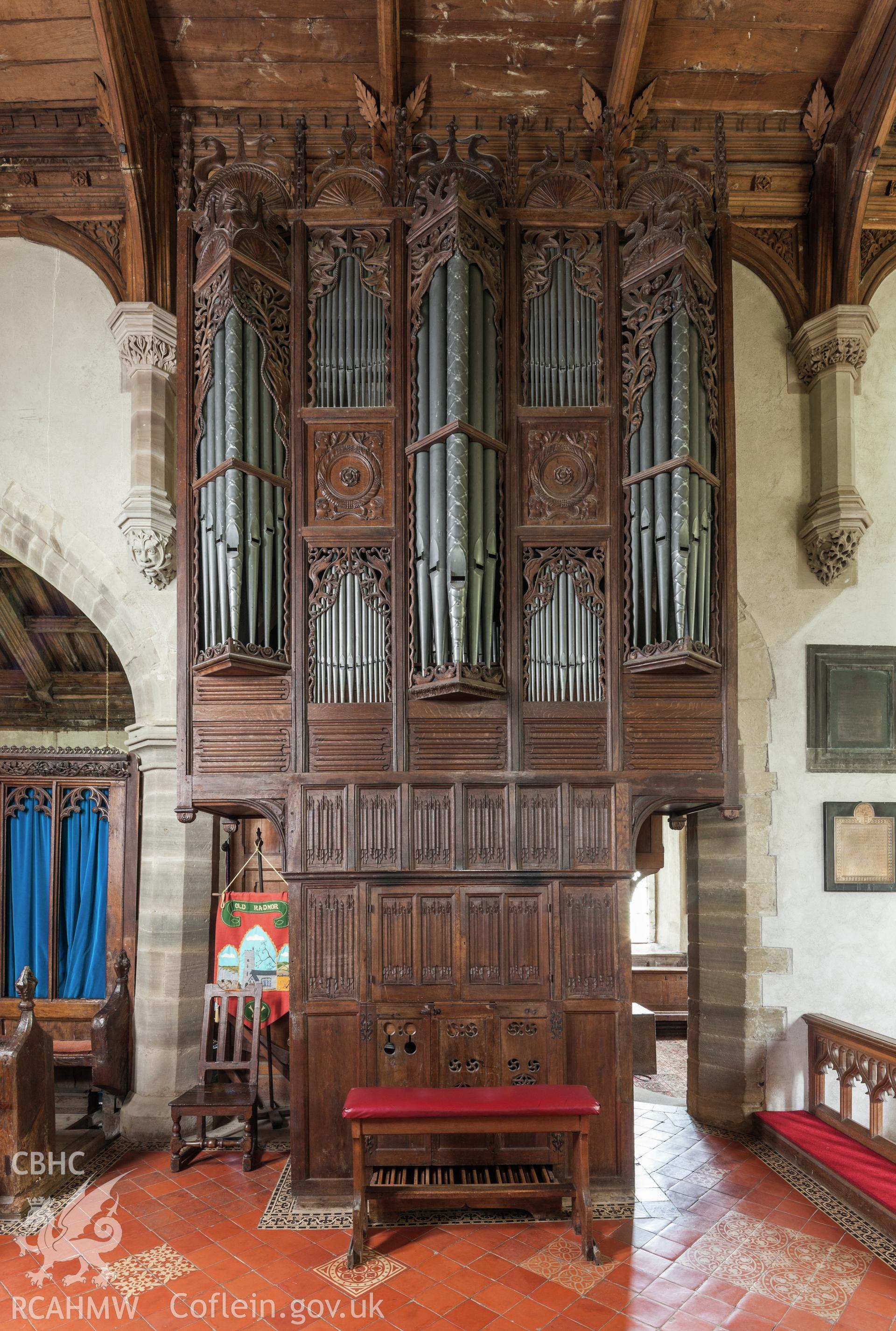
English Organbuilding history
Canada and the USA both started as English colonies, and their organ industries where based on 19th century English imports and English organbuilding immigrants. So as a Canadian, I'm very interested in English organbuilding. (Photo: St Stephen's Church, Old Randor Powys, Wales, ~1515.)
However I am neither historian nor academic. There are a number of excellent books about the history of the English organ. Because of the destruction of the organs during the Commonwealth, and later rebuilding and replacement of "archaic" organs, information about the early instruments consists mostly of stoplists and recycled cases and pipes.
Not much else survived. Therefore, after a brief historical summary, I'm going to limit my discussion to about after 1800...
Periods of English Organbuilding
- Before 1650
- 1640 Destruction of the organs during the Commonwealth.
- 1660 Restoration, up to Smith & Harris
- Father Smith vs. Renatus Harris
- 1700 Eighteenth Century
- 1780’s Samuel Green
- 1800-1830 Transition towards the Victorian organ
- 1830-1850 Hill-Gauntlett
- 1851-1900 Willis, Schulze, Hope Jones
- 1900-1940 Arthur Harrison
Medieval Origins (10th–15th Centuries)
Organbuilding dates back to the 10th century, with one of the earliest known pipe organs installed at Winchester Cathedral around 980 AD. This was a monumental instrument requiring multiple people to operate the bellows. During the medieval period, organs were primarily used in monastic and cathedral settings to accompany plainchant.
An organ before 1600 would have been no more than a single manual, large scaled positiv of half a dozen stops, probably sliderchest, perhaps with a long compass:
- Old Dutch and Italian influences
- the 22th, long compasses, and lack of pedals, suggest Italian influence
- The 22nd (1’) may, or may not have broken back to 1-1/3’
- Little known, no surviving instruments, no scales, only stoplists and the Old Radnor case.
- We can assume they were like the contemporary continental organs.
- Lots of wood pipes
- Duplicated stops, perhaps of differing power and scales
- very few stop types, no reeds or mixtures
- no pedals
- Small vs Large usually referred to an octave higher, not to scale.
- Composers: Byrd, Gibbons, Bull
- Builders: Thomas Dallam, John Howe, John Burward
Reformation and Destruction (16th–17th Centuries)
Smaller, more modest instruments began appearing in parish churches. The English Reformation under Henry VIII led to the dissolution of monasteries and destruction of many organs. Organ building came to a complete halt in 1644, when Parliament passed an ordinance ordering all organs in churches and chapels to be "taken away and utterly defaced".
For eighteen years, organs were silent in England. The period of Cromwell’s Commonwealth, 1630-60 resulted in the destruction of virtually all the organs. The builders went into other trades, or fled to the continent.
Restoration and the "Father Smith" Era (1660–1700)
When the organbuilders returned, they built in the old way, but with European, especially French influences (Brittany & perhaps Normandy, not Île-de-France).
Up until the time of Hill, the organ was a Great or main organ, a Chaire or Choir (Positiv) secondary organ, with possibly other subsidiary manuals of short compass, like an echo or swell.
Chamber organs always started at C8’. Church organs started lower, 16’G was usual in the 17th and 18th century. This was because the organs lacked pedals. Secondary manuals, such as Swells, were considered as treble solo manuals so had a short compass in the bass. Cases were 14’ high above the impost, to accommodate the 11 foot long body, plus the foot, of 16’G. Three pipe towers suited these long pipes, and made for graceful cases.
Builders
- Robert, Ralph, George and Thomas Dallam, London
- Thomas Harris, New Sarum
- Edward Darby
- William Hathaway
- Robert Hayward, Bath
- John Hingeston
- John Loosemore, Exeter
- Thomas Thamar, Peterborough
- Lancelot Pease
- Preston, York
Typical Organ, Canterbury Cathedral, Lancelot Pease, 1662
Great Organ
- Diapason
- Diapason Stopp
- 2 Principals
- 2 fifteenths
- A small & great twelfth metal (2-2/3 and 1-1/3, i.e. big & small?)
- 2 Twenty-seconds metal
- Flute metal
- Recorder metal
- Tierce metal
Chaire Organ
- 2 Stop’t Diapasons wood
- Principal metal façade
- Fifteenth metal
- fifteenth wood
- flute wood
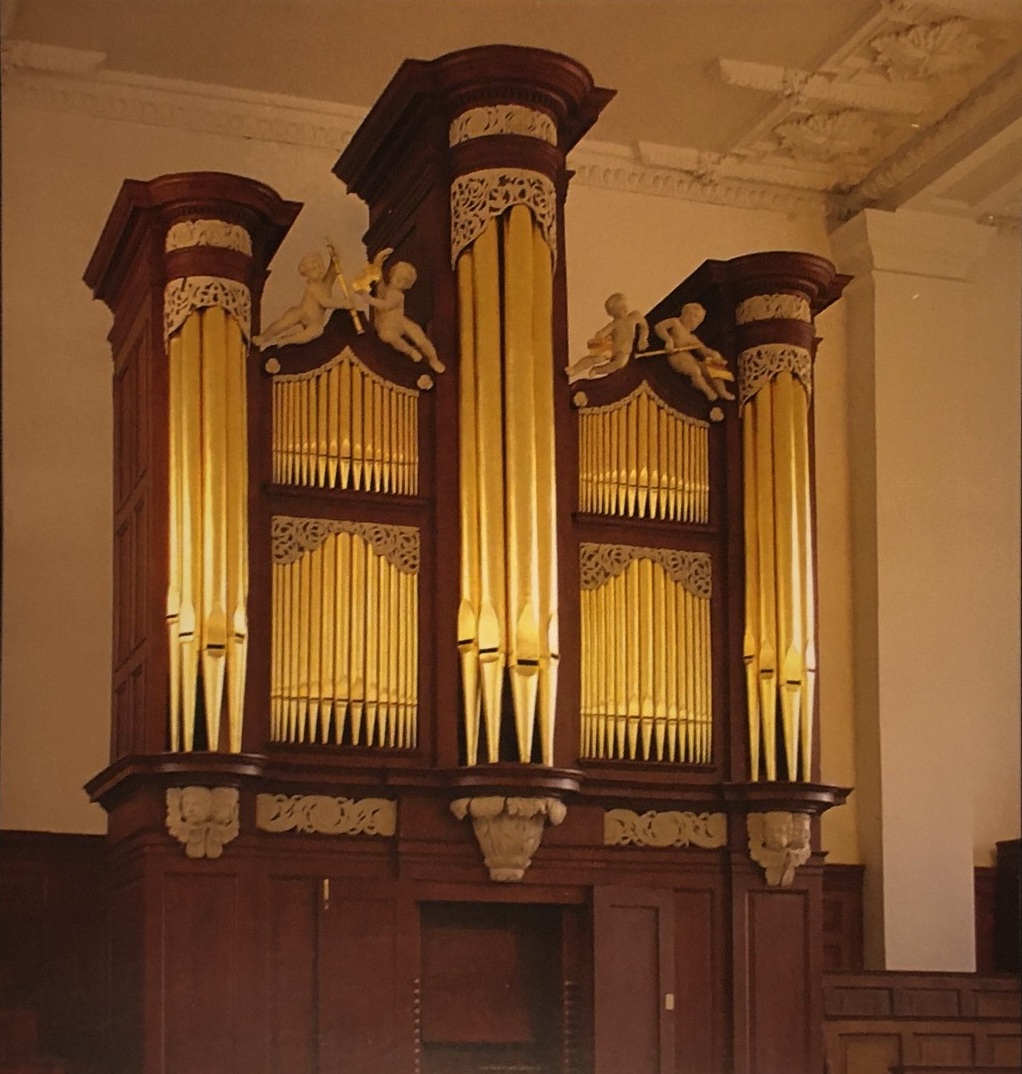
English Organbuilding Harris vs Smith
Following the Restoration of the monarchy in 1660, there was a significant revival. Foreign builders were invited to settle in England, most notably Bernard "Father" Smith (a German builder) and his rival Renatus Harris (a french builder). Smith was known for sweet voicing, while Harris was renowned for mechanical quality.
Their fierce competition produced landmark instruments in St Paul's Cathedral and other major churches. The organs to the 1700's were simular to organs in Brittany, Normandy and Holland. (Photo is Renatus Harris, St Botolph, Aldgate; note the elegant 16’G facade in the case).
Father Smith vs. Renatus Harris
Contrasts
- Father Smith <-- --> Renatus Harris
- High pitch? <-- --> low pitch?
- Trained in Dutch-German <-- --> trained in France
- Poor actions <-- --> Better Actions
- Seldom used separate 17th or 19ths <-- --> Used separate 17th and 19th
- Usually used tierce in mixtures <-- --> seldom used tierce in mixtures
- Patronized by the Crown <-- --> no Patron
- Narrower Diapasons <-- --> Broader Diapasons
- Germanic <-- --> French
- Lots of Wood pipes <-- --> only a few bass wood pipes
- Poor reeds <-- --> Good reeds
Similarities
- Both had foreign experience
- by 1680’s Smith was making frenchified schemes
- both ignored pedals, though pulldowns, tremulants, and couplers may have simply not mentioned in contracts
- Both preferred (in leu of Pedals) long compasses: 16’ GG in most organs, FF at Temple
- Two and a half manuals, was common
- No organ larger than 30 stops
Most English organbuilders followed either the Germanic Smith, or French Harris pipe traditions, even if they don’t know the origin and just copied their master.
from Sir John Sutton: “A Short Account of Organs” - 1847
About Father Smith:
The chorus is very fine and very brilliant in effect, though not quite so as the Chorus afterwards introduced by Snetzler in his organs which, though extremely brilliant, is almost too shrill, and when heard in a small building rings unpleasantly in the ears. The great beauty of Schmit’s organs consists in the sweetness and brilliance of the wooden pipes.
About Harris:
His Diapasons are both sweet and rich and his chorus vivacious and ringing, even more so than Schmid’s, and his reed stops, though far inferior to those made at the present (1847), are also superior to Smith.
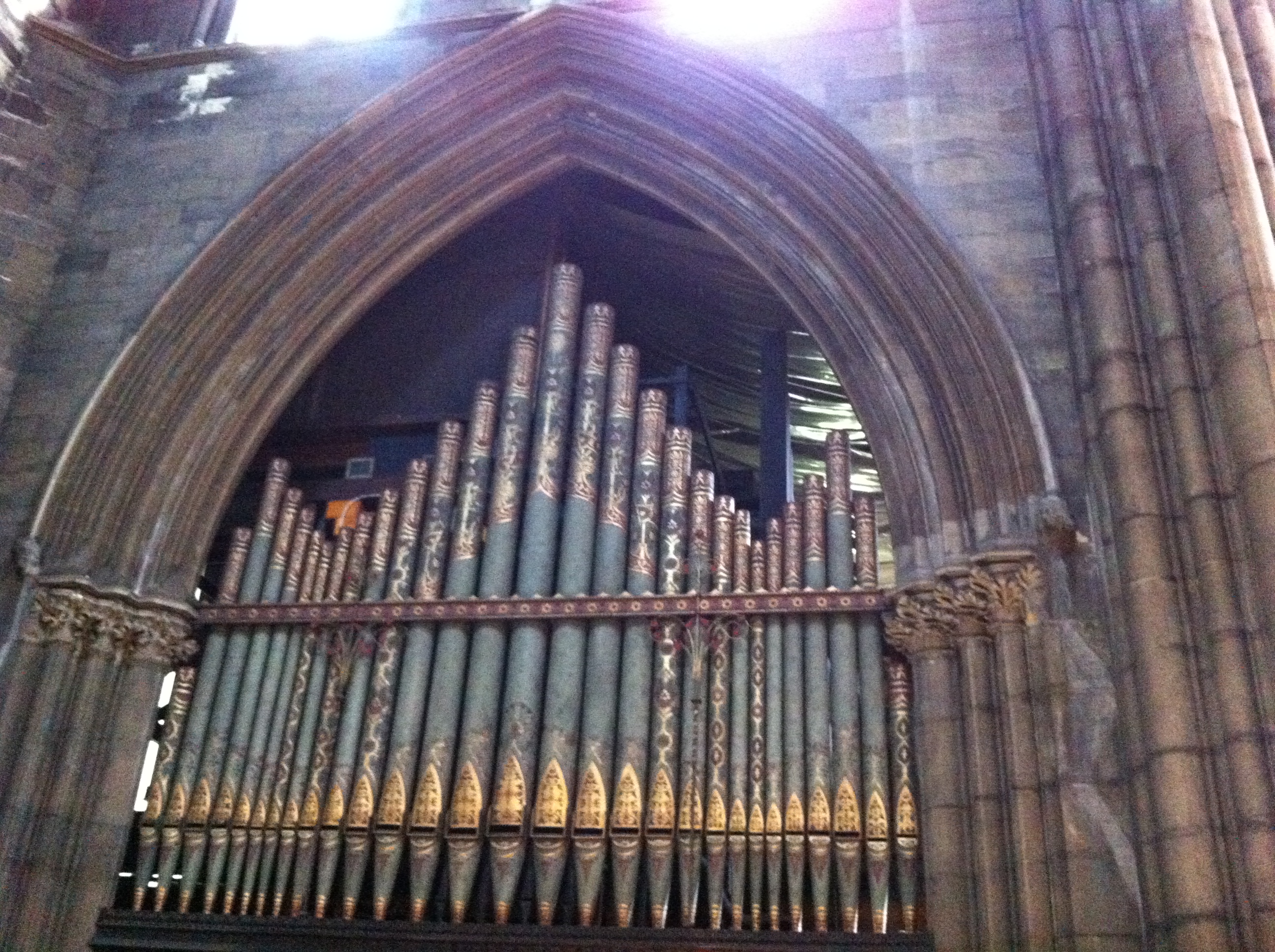
Romantic English Organbuilding, Victorian Era (19th Century)
I'm using the term "Victorian Era" loosely, to include the 19th Century. The 19th century marked both an organbuilding disaster, and a golden age. It marked the loss and destruction of almost all the previous pipe organs, to be replaced by a new style of organbuilding. (Photo: Edmund Schulze Organ of Paulinzelle in Saxony, 1862 in St. George’s Doncaster.) The causes of this revolution were:
- England became wealthy, thanks to the looting of its colonies and the industrial revolution.
- The desire for huge, powerful organs, befitting a hegemonic empire.
- The Gothic Revival and a surge in church construction created high demand for new organs.
- Need for loud organs to lead massed hymn-singing congregations.
- Collaboration between organbuilder William Hill and Henry John Gauntlett and...
- Felix Mendelssohn's organ recitals and influence, leading to...
- Introduction of the German organ system.
- Influence of imported organs of Edmund Schulze of Paulinzelle in Saxony.
- Fix the preceived shortcomings of the 18th century organ
There were many faults the Victorians identified with the 18th century english organ. So extensive were the faults, that a mere rebuild wouldn't do; replacement was required. In just a few decades, the previous 3 centuries of British organbuilding history was wiped away, replaced with the Victorian Organ. Ancient casework was discarded, because the new bloated organs couldn't fit inside them. Faults of the old:
Faults such as pedals, which were not introduced into England until the close of the 18th century; roughly 400 years after Germany had them. Meantone survived in England upto 1850's, when everyone else abandoned meantone a century earlier.
- Lack of full compass pedalboard and independant pedal stops
- Lack of power to lead massed hymn-singing congregations
- Meantone tuning
- Swell lacked full compass
- lack of 8' orchestral stops
The English Romantic school was a gradual evolution driven by a few great builder families. Those builders were influenced by the reasons mentioned above. They were also inspired by the changing demands of Anglican Choral tradition and the burgeoning concert hall. Innovations including pneumatic and electric actions allowed for greater complexity, while mass production enabled wider distribution.
The result was a powerful, "orchestral" instrument, suited to the repertoire of Victorian and Edwardian England. Besides accompanying the demanding Anglican Choral Service, the organ had to lead large masses of congregational hymn singing. Romantic english organs were built from a rich 8' foundation and powerful, smooth reeds.
I am neither a historian nor scholar, so will simply concintrate on the work of two English builders: William Hill & Son (1832-1916), and "Father" Henry Willis (1821-1901)
1) William Hill & Son (1832-1916) was the other prominent, large firm. They had a long history of building magnificent Romantic instruments.
2) "Father" Henry Willis (1821-1901), was a meticulous craftsman and a brilliant designer, whose instruments defined the sound of an era. They had a solid foundation of traditional organ voices as well as "orchestral" stops, useful for the transcribing orchestral works. Father Willis was famous for the unparalleled quality of his reed stops. They were powerful, brilliant, and characterful, yet they could also blend seamlessly into the full ensemble.
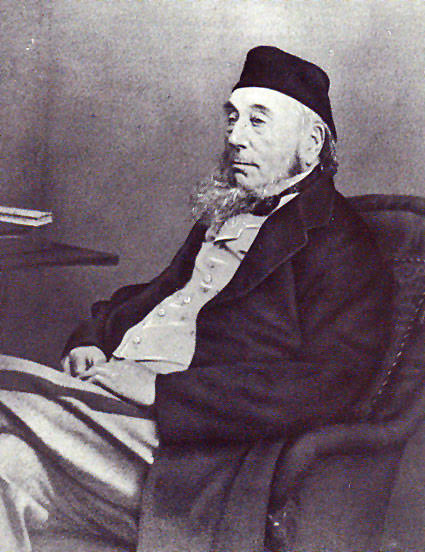
William Hill & Son, Introduction
William Hill was my favourite English organbuilder. There are a number of excellent books of William Hill & Son, and the shop books with scales are available, so I'm not going to repeat them here. The big organs are famous and documented elseware, so I'll show a couple of smaller ones. Their limited resources show what Hill prioritized.
I was able to crawl thru and scale some of the pipe work of St Johns Church, 1867, Hyde Park Crescent. I also examined the Hill from St Andrew’s Cathedral, Sydney, Australia, in 1997, when it was at the Létourneau Organ Co (Canada), for restoration. My friends at Létourneau gave me the opportunity to examine and scale some pipes.
William Hill was a pivotal figure in 19th-century English organ building, and his company, William Hill & Son, became one of the most important firms of the era. They were renowned for their large-scale instruments in cathedrals and town halls, as well as for their innovative contributions to organ design.
The firm's roots trace back to 1755 when it was founded by John Snetzler. William Hill became a partner in 1825, working with Thomas Elliott (his father-in-law) in the firm Elliott and Hill. He took over the company upon Elliott's death in 1832, and by 1838, it was renamed in his honor. William's sons, William and Thomas, joined the firm, with Thomas taking control after William's death in 1870. The company continued under Thomas's son, Arthur George Hill, until 1916.
In 1916, the company merged with Norman & Beard to become William Hill & Son & Norman & Beard Ltd., later known as Hill, Norman & Beard. This new entity continued building organs and even produced theatre organs under the brand name "Christie". The business was eventually wound up in 1998.
Notable Hill Organs
William Hill & Son built organs for some of the most prestigious venues in the UK and around the world. They remain highly regarded for their quality and craftsmanship and can still be found in active use and in various states of preservation around the globe.
- Birmingham Town Hall, 1832 - A monumental 4-manual organ, one of Hill's early major works and the first to feature his high-pressure "Grand Ophicleide" stop .
- King's College Chapel, Cambridge, 1834 - Another significant early commission for a prestigious location.
- Ulster Hall, Belfast, 1861-62 - The "Mulholland Grand Organ," a gift to the city, which still exists today.
- Sydney Town Hall, 1886-89 - At the time of its completion, it was the largest organ in the world, with a case designed by A.G. Hill.
- Westminster Abbey, 1848 - The firm built an organ for the Abbey and worked on it in 1884, 1895, and 1909. Much of this organ was replaced in 1937, though some of Hill's pipework was retained.
Innovations
William Hill is credited with introducing several new stops and design elements to English organ building, inspired by German instruments of the time. These included stops like the Harmonica 4', Wald Flute, and Suabe Flute. He is also known for creating the first high-pressure register, the Grand Ophicleide 8' on the Birmingham Town Hall organ. A chamber organ he built in 1837 also features the earliest known occurrence of the Claribella stop.
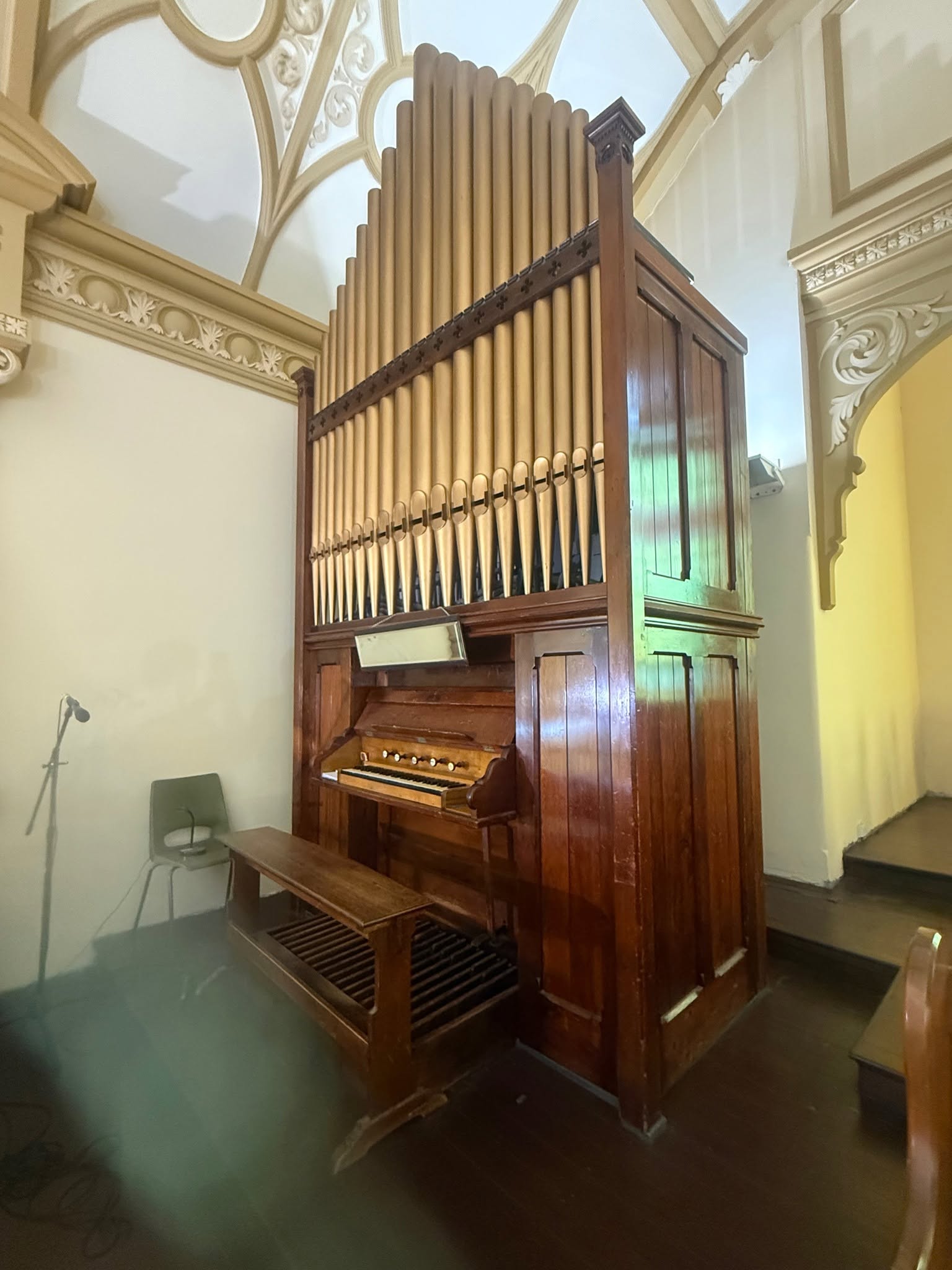
1872 - Hill & Son, St Augustine’s Church, Yarraville, Australia
This is a delightful little 1872 Hill & Son pipe organ at St. Augustine’s Catholic Church in the suburb of Yarraville (Melbourne, Victoria, Australia). Pipe Organs Victoria now maintain it. The bellows have been releathered relatively recently. There is more preventative work to be done in the future but it is all in good working order and speaks well into the generous acoustic with an ever slight reverberation; helped along with the curved ceilings in the well cared for and looked after building.
There is a swellbox with hitch-down pedal, for the pipes (excluding the facade (Open Diapason 8').
Great 1-56
- Open Diapason 8'
- Dulciana 8'
- Stopped Diapason 8'
- Principal 4'
- Waldflute 4'
Pulldown pedal 1-30
Photos and notes 2026 by Anthony Hahn.
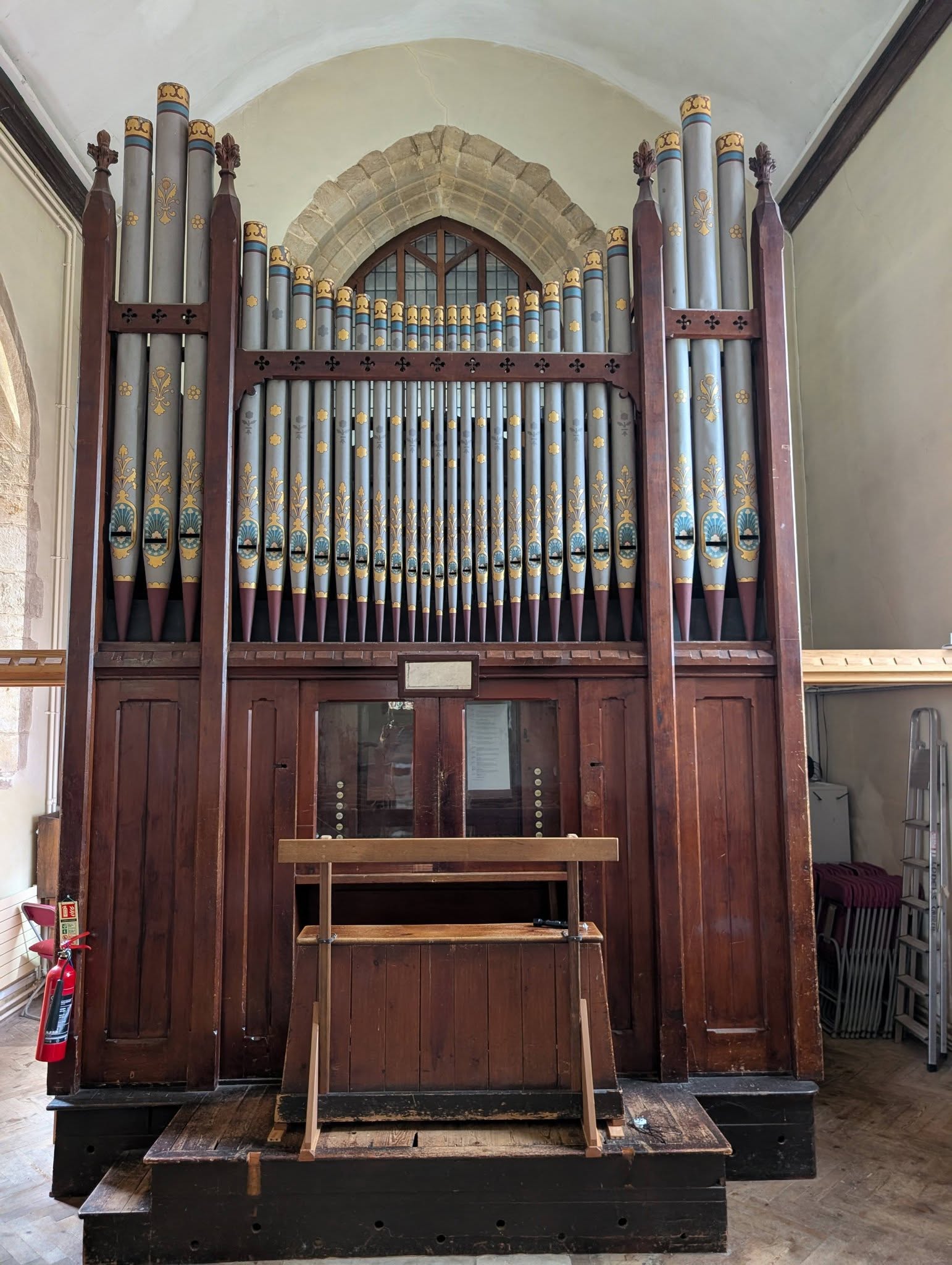
1864 - William Hill & Son, Loders, Dorset
This organ of the early times when Thomas Hill became partner of his father, was constructed to be placed on the west end gallery in St Bartholomew's Crewkerne at a cost of £365. 1906 it was moved to Loders replacing a small organ of an unknown builder. The sound is fresh and powerful. Note the narrow scaled Trumpet like that in the 1845 organ of Ashton under Line.
The Swell is in fact a ten C but sounding with the Stopped Diapason in the lowest octave. The stop labels seems to have been replaced during the 1906 moving to it's new home. But this could be done by the Hill firm.
The Pedal stop is an open wooden stop. However, it has narrow mouths, but deeper bodies and lower cutups, so isn't going to be like the Edwardian massive, dull open woods.
Great (C-g3)
- Open Diapason 8
- Stopped Diapason 8
- Dulciana 8
- Principal 4
- Wald Flute 4
- Twelfth 2 2/3
- Fifteenth 2
- Mixture III
- Trumpet 8
Swell (C-g3)
- Stopped Bass 8', 1-12
- Open Diapason 8, tc
- Stopped Diapason 8, tc
- Principal 4, tc
- Cornopean 8, tc
Pedal (C-f1)
- Open Wood 16'
Photos and notes 2026 by Hannes Ludwig.
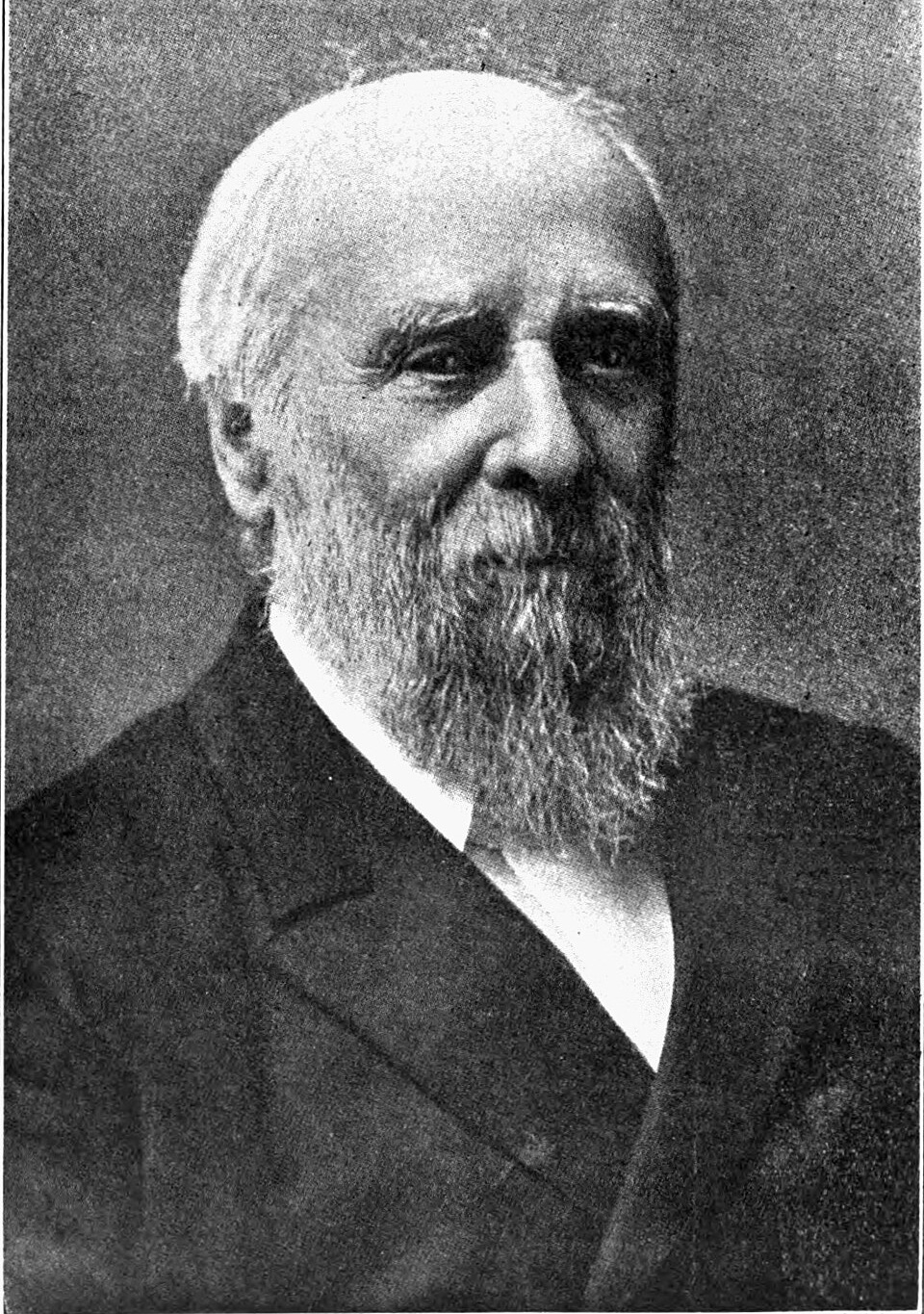
(Father) Henry Willis, Introduction
"Father" Henry Willis (1821-1901), was the preeminent builder, but he was surrounded by a rich ecosystem of builders. He was a meticulous craftsman and a brilliant designer whose instruments defined the sound of an era . Evan though his organs were awell-balanced tonally, with a solid foundation of traditional organ voices the were called called "orchestral" because Willis included stops designed to imitate the sounds of the orchestra. This made is organs useful for the transcribing orchestral works for the organ, which was quite populat at the time.
Father Willis was famous for the unparalleled quality of his reed stops. They were powerful, brilliant, and characterful, yet they could also blend seamlessly into the full ensemble. A "Father Willis reed" is still considered the gold standard by organists and builders today. Unlike some of his competitors, Willis's specifications included a lots of mixtures and upperwork, which prevented the organ from becoming muddy, even in the vast acoustic of a cathedral.
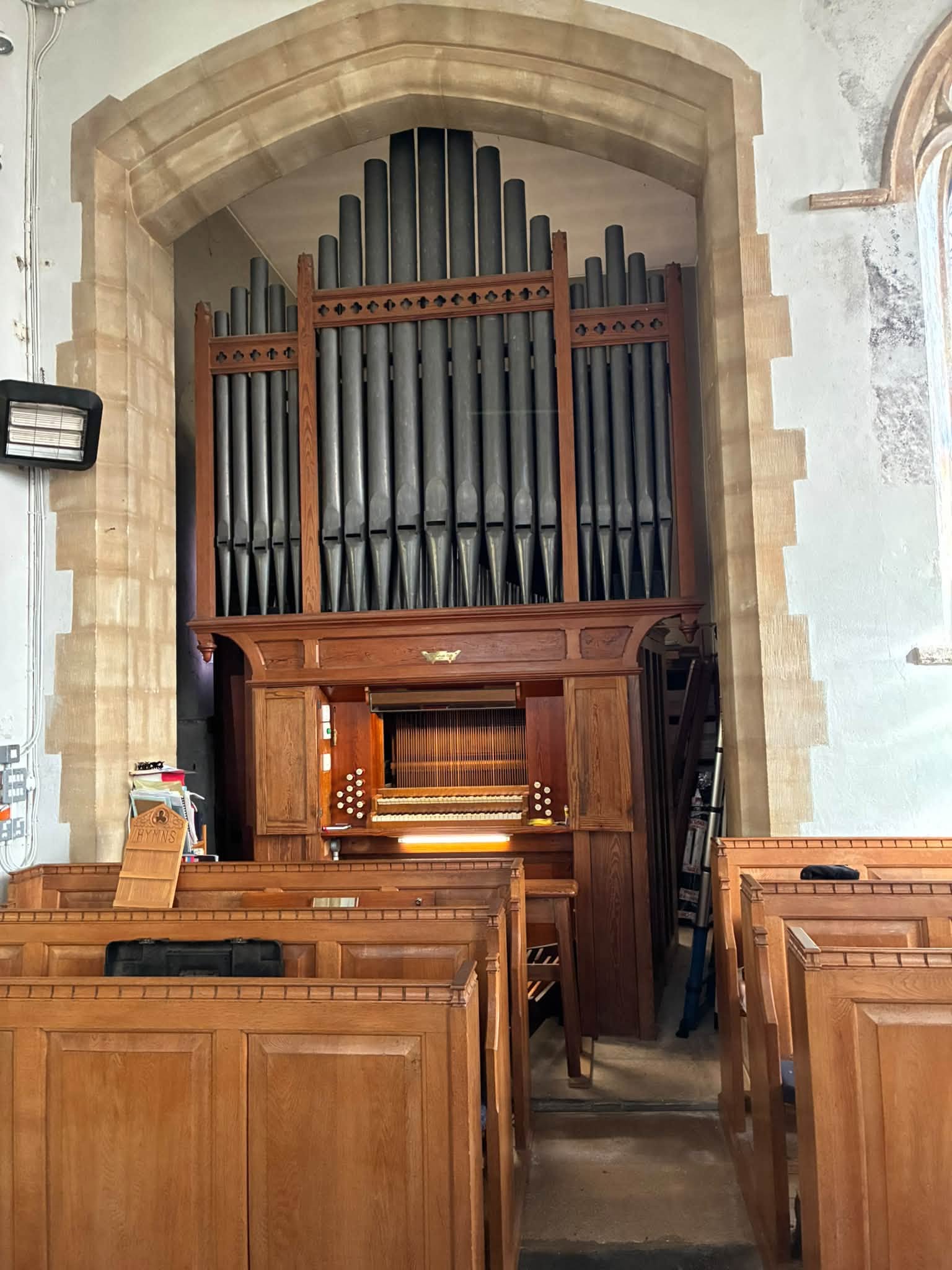
1893 - Sweetland organ, St Piran’s Perranarworthal
I show this late Victorian organ (1893 Sweetland organ, St Piran’s Perranarworthal, Bleadon in Somerset), because of its wonderful casework. The facade goes down to bottom 8' CC. It has excellent proportions, with a narrower case below the impost, compared to the simular sized Hill organ at Yarraville, (see above), which is just a rectangular box. Even worst (but very commonly done) is when an organ is placed in an alcove, with the opening blocked off with a picket fence of facade pipes.
The tuner, Lance Foy, says it is "a basic two manual in fair order, but someone in the past felt it necessary to put the swell on pneumatic and provide octave couplers. The suspicious Fifteenth and Nazard appear to be original".
Great (C-g3)
- Open Diapason 8
- Principal 4
- Stopped Diapason 8
- Fifteenth 2
Swell (C-g3)
- Open Diapason 8, tc
- Lieblich Gedacht 8
- Principal 4
- Nazard 2-2/3
- Oboe 8
- Sw Suboctave
- Sw Unison Off
- Sw Octave
Pedal (C-f1)
- Bass Flute 8
- Bourdon 16'
- Sw Gt
- Sw Ped
- Gt Ped
English Organbuilding, Edwardian Period
I'm using the Edwardian Period very loosely, perhaps 1900-1950. The 20th century brought England another organbuilding disaster. The loss of the colonies, WWI and WWII devastated the British economy. Financial pressures has their usual effect on quality.
And the sons of organbuilders inherited the family business, but seldom the organbuilding genius of their progenitor. Mechanical design and innovation lagged behind the Americas, which had fast electro-pneumatic actions, reliable combination actions and comfortable consoles.
Tonally, the early 20th century English organ, is pictured as a sound that is rich, smooth, and fundamentally orchestral. It is a departure from the brighter, more transparent voicing of the Victorian era and a world away from the neo-Baroque clarity that would follow later in the century.
The AI "Deep-Seek" gives it the following key tonal characteristics:
1. A Foundation of Diaphone and Tibia
The pedal and lower manual departments were anchored by enormous, dark-toned flue stops—often Diaphones (a distinctive English reed-like flue) and huge Open Wood basses. The 32′ and 16′ registers were felt as much as heard, providing a rolling, thunderous foundation rather than a sharp, defined pitch.
2. Smooth, "Horn-like" Flutes
Flutes were voiced to be round, fat, and hollow, often with a slight "hole" in the tone. Stops like the Claribel Flute, Lieblich Gedeckt, and Harmonic Flute had a liquid, almost vocal quality. They were not the chirpy, chiffy flutes of the Baroque; they were mellow and blending.
3. String Stops with a Vocal, "Celli" Quality
The Violin d'Orchestre, Viole d'Orchestre, and Salicional were voiced to imitate orchestral strings—sweet, slightly reedy, and with a slow, throbbing tremulant. They were not the thin, keen strings of earlier builders; they were lush and expressive.
4. Reeds: Bold, Smooth, and "Tubby"
English reeds of this period—Trumpet, Oboe, Clarion, Trombone—were often voiced on heavy wind pressures (10–20 inches or more) and had a thick, round, sonorous quality. The Tuba was a colossal, smooth-toned stop, not a snarling bombarde. The Cornopean and Horn were smooth and vocal. There was little of the biting, buzzing quality of French or German reeds.
5. A Massive, Blending Diapason Chorus
The Open Diapason was the king. It was voiced full, round, and powerful, with a strong fundamental and a relatively subdued harmonic development. The chorus built up not with sharp mixtures but with stopped diapasons, flutes, and reeds added for weight and color. The Full Organ was a smooth, overwhelming wall of sound—grand, not brilliant.
6. The Swell Box as an Expressive Tool
The Swell was the heart of the instrument. With its enclosed reeds, strings, and flutes, it allowed for gradual, emotional crescendos and diminuendos—a hallmark of Romantic expression. The Tremulant was broad and slow, adding a sentimental, almost human vibrato.
7. Orchestral Transcription and Color
Builders like Henry Willis III, Harrison & Harrison, and Hill & Son designed organs to imitate the orchestra: Oboe, Cor Anglais, Orchestral Trumpet, Flute, Cello, and Harp stops. The organ was a symphonic instrument, not a liturgical one in the Baroque sense.
8. Overall Aesthetic: Warm, Dark, and Lush
The sound was not bright or transparent. It was thick, cohesive, and emotionally warm, with a strong fundamental bias and a rolled-off treble. The mixtures were often low-pitched and smooth (e.g., a Sesquialtera or Mixture that reinforced the 8′ and 4′ rather than adding sharpness). The result was a sound that could whisper, roar, and weep—perfect for the Romantic repertoire, Anglican chant, and the transcriptions of Bach and Wagner that were then in vogue.
In short: a tonally opulent, orchestral, and emotionally expressive instrument - dark, smooth, and grand, with the Swell box as its soul. Tonalities prized at the time, but (except for a few luddites), has now fallen out of favor. As I don't like these organs, and ignored them, I'll skip giving examples...
Mid-20th century Organ Reform Movement
Mid-20th century brought the Organ Reform Movement, which sought a return to the clarity and tonal style of earlier Baroque instruments, often reacting against the more romantic, orchestral sound of Victorian organs. Today, British builders such as Harrison & Harrison and Nicholson & Co. continue the tradition. However, the craft is now listed as endangered, with only 11–20 companies offering a full range of organ building services.
- Bicknell, Stephen - British Organ from 1850, ISO Lecture - 1996
- Willis Oboe boots, ACAD file
- Hill Gt & Ch chest layout ACAD file
- The Englishness of the English Organ - Thistlethwaite
- Dictionary of Organs and Organists - 1921
- Harris organ in Guimiliau, 1676
- Old Radnor Case, 16th Century, by Goetze and Gwynn
- Old Radnor Case, 16th Century by Bicknell
- Fr Smith organ, 1698, Gt St Marys, Cambridge

Canadian Organbuilding
Canada, and the Evil Empire to the south of us, both started as English colonies, and their organ industries where based on 19th century English imports and English organbuilding immigrants. Nineteenth century Boston, Massachusetts, became the leading organ building center of the USA with famous early builders like:
- Elias and George Greenleaf Hook founded in Salem, Ma., 1832 moved to Boston, 1827-1871
- became E. & G.G. Hook & Hastings, 1871- 1936
- William M. Goodrich (1777–1833),
- George Stevens (active from 1830s)
- Thomas Appleton, Boston (1811-1872)
Samuel Russell Warren (1809-1882)
Samuel Russell Warren trained in Thomas Appleton's workshops in Boston. He emigrated from Boston in 1836, and established his Montreal workshop. Warren built more than 350 organs, establishing himself as the leading Canadian organbuilder. Warren reorganized as S.R. Warren & Sons about 1879 with his sons: Samuel Prowse Warren as a silent partner, and Charles Sumner Warren as an active participant in the shop. In 1879 they relocated to Toronto.
Warren build a superior organ, both tracker action and tonally. But they had difficulty making the transition to "modern" tubular-pneumatic and electric action. So in 1896 the business was sold to Dennis W. Karn, and moved to Woodstock, to become the Karn-Warren Organ Co, managed by Warren's son, Charles Sumner Warren.
With new blood and money, Karn-Warren reestablished itself as a leader in Canada's organbuilding, with excellent voicing and a newly perfected tubular-pneumatic action. In 1913 Charles Sumner Warren resigned and they renamed the company "Karn-Morris Organ Company".
Unfortunately, the collapse of Karn-Morris' piano trade and loss of staff due to WWI recruitment, brought down Karn-Warren about 1920.
The staff reorganized, and the company was reborn as The Woodstock Pipe organ Company. Even though Woodstock kept William Potter (the K-W voicer), Woodstock organs were much more orchestral and sometimes even made horseshoe consoles.
Casavant
The other major player of Canada's early organbuilding history was Casavant Frères. It was founded in 1879 in St-Hyacinthe, Quebec, by brothers Joseph-Claver and Samuel-Marie Casavant. Warren organs sounded better, the Casavant brothers were innovators. Casavant embraced the new technology of electricity.
By the 1890s, they were building organs with electro-pneumatic action for both the keys and stops. This allowed for lighter touch and more flexible consoles, and the construction of huge organs. They developed an extremely reliable, quiet and comprehensive piston memory system. By 1930, Casavant had installed over 1,350 instruments across Canada, the US, and as far away as Europe, Africa, and Japan. Today, Casavant is still building fine pipe organs.
Despite being located in Quebec and using french-labelled stop tabs in french-speaking Quebec, hiring a Cavaille-coll voicer, and their later marketing claims, Casavant built a solidly english-style organ, as the USA and english Canada was their market.
The Mid-20th Century: The Organ Reform Movement
Influenced by the mid-20th-century German Orgelbewegung, many organists felt that the grand electro-pneumatic instruments of the Casavant era had become "insipid" and lacked the clarity. They sought to return to the aesthetic principles of the Baroque era, reacting against what they saw as the excesses of Romantic and symphonic organs. This dissatisfaction sparked the Organ Reform Movement in Canada.
The turning point came in 1959, when a new tracker-action organ built by Germany's Rudolf von Beckerath was installed in Montreal. A group of Quebec organists formed Ars Organi to promote the performance of organ literature on these "authentic" instruments.
Casavant was in trouble. Though their organs were finely crafted, nobody wanted Dulcianas or Melodias any more. Casavant responded by hiring former Aeoline-Skinner voicer Larry Phelps. Phelps taught Casavant how to build and voice the new stops, and he convinced Casavant to hire european trained tracker builders Hellmuth Wolff and Karl Wilhelm to re-establish a tracker-action department in 1963. His proficency at closing sales got him the tonal director job, then vice-presidency, until office politics got him fired. Gerhard Brunzema became the new tonal director and so Casavant organs became more historically informed.
Canadian Builders
There were also many smaller Canadian builders:
- S.R. Warren & Sons 1836-1896
- Karn-Warren Pipe Organ Co, 1896-1820
- Woodstock Pipe Organ Builders, 1920-~1950
- Casavant Freres, St-Hyacinthe, Que, 1879-
- Lye Organ Co, Toronto 1864-1930's
- Williams Organ Company, Toronto
- Karn Organ company
- Keates Pipe Organ Builders
- Hallman Organ Company, Kitchener, ON, 1964-1973
- John Bright, London, On
- Franklin Legge Organ Co, Toronto, 1915-1947
The Modern Tracker Builders
The post-1960s revival produced several firms that gave Canada an international reputation for high-quality, historically informed organbuilding.
- Casavant Freres
- Hellmuth Wolff (Laval, QC): A Swiss immigrant who worked at Casavant, Wolff founded his own shop in 1968. He became a leading figure in the Organ Reform movement, specializing in mechanical-action instruments inspired by French and German classical traditions. His firm built over 40 organs, about half in the US.
- Karl Wilhelm (Mont-St-Hilaire, QC): Also Swiss-trained, Wilhelm worked at Casavant before starting his own workshop in 1966. His organs are known for their rich and powerful sound.
- Gabriel Kney (London, ON): German-born Kney moved to Canada in 1951. After a partnership in the 1950s, he formed his own firm in 1967. By 1990, he had built more than 130 organs across North America, including a notable instrument at Roy Thomson Hall in Toronto.
Canadian Organbuilders, Samuel Russell Warren (1809-1882)
Professional organbuilding began in Canada, in 1836, when American Samuel-Russel Warren settled in Montréal. He had been trained at Thomas Appleton's workshops in Boston. This remarkable man gave to our organbuilding craftsmanship a traditional and solid foundation while, at the same time, imported and introduced new technologies such as the Barker machines (1851), the hydraulic blower (1860) and stops like harmonic flutes and free reeds. He trained disciples who became famous. Among them, Louis Mitchell and Charles-Summer Warren, his youngest son whose children and grandchildren were involved in organbuilding until the 1950s. His success and that of his firm was great. He built more than 400 instruments mainly for Montréal but also for Québec, Ontario and the United States. His largest instruments have been lost or have been incorporated, anonymously, into new ones. Fortunately, some positifs, like the ones in Chambly and Frelighsburg, bear witness to the great qualities of that organbuilding craftsmanship.
-
"An Organ for Today", Lawrence Phelps - 1970
Address delivered to Connecticut AGO, at the Choate School, Wallingford,
by LAWRENCE PHELPS, April 13, 1970 - 1961 Casavant (early Phelps)
- Lots more to come...
Edward Lye and Sons, 1864-1930's
- Lye Brochure and Opus list
- Lots more to come...